Introducing House with Slanted Lattice, a custom-built home example by an Archi-Lab. First-Class Architect Office, a Architect / Design office in Heights S&A 2F, 4-20-31 Awaji, Higashiyodogawa-ku, Osaka City, Osaka Prefecture
House with Slanted Lattice
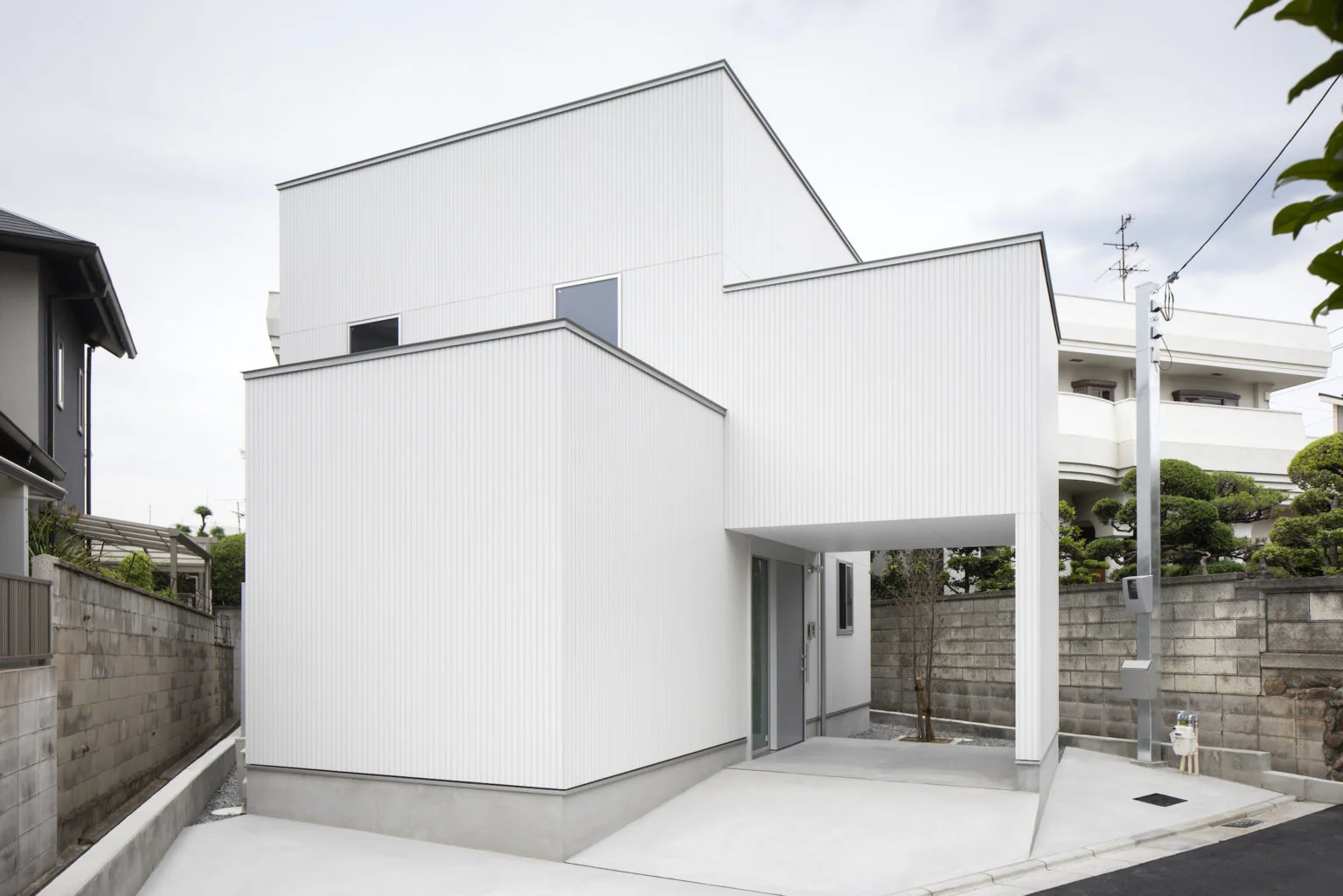
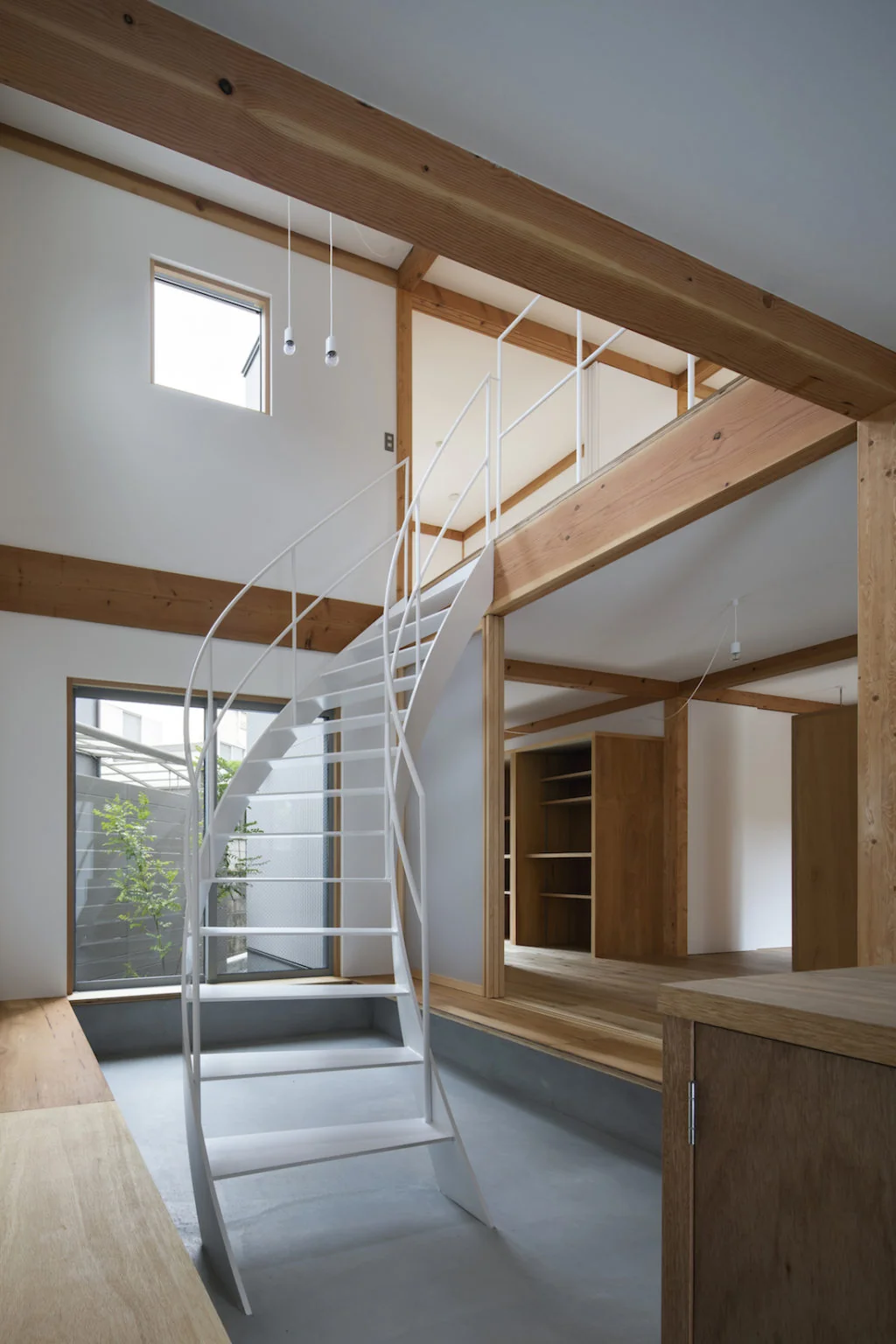
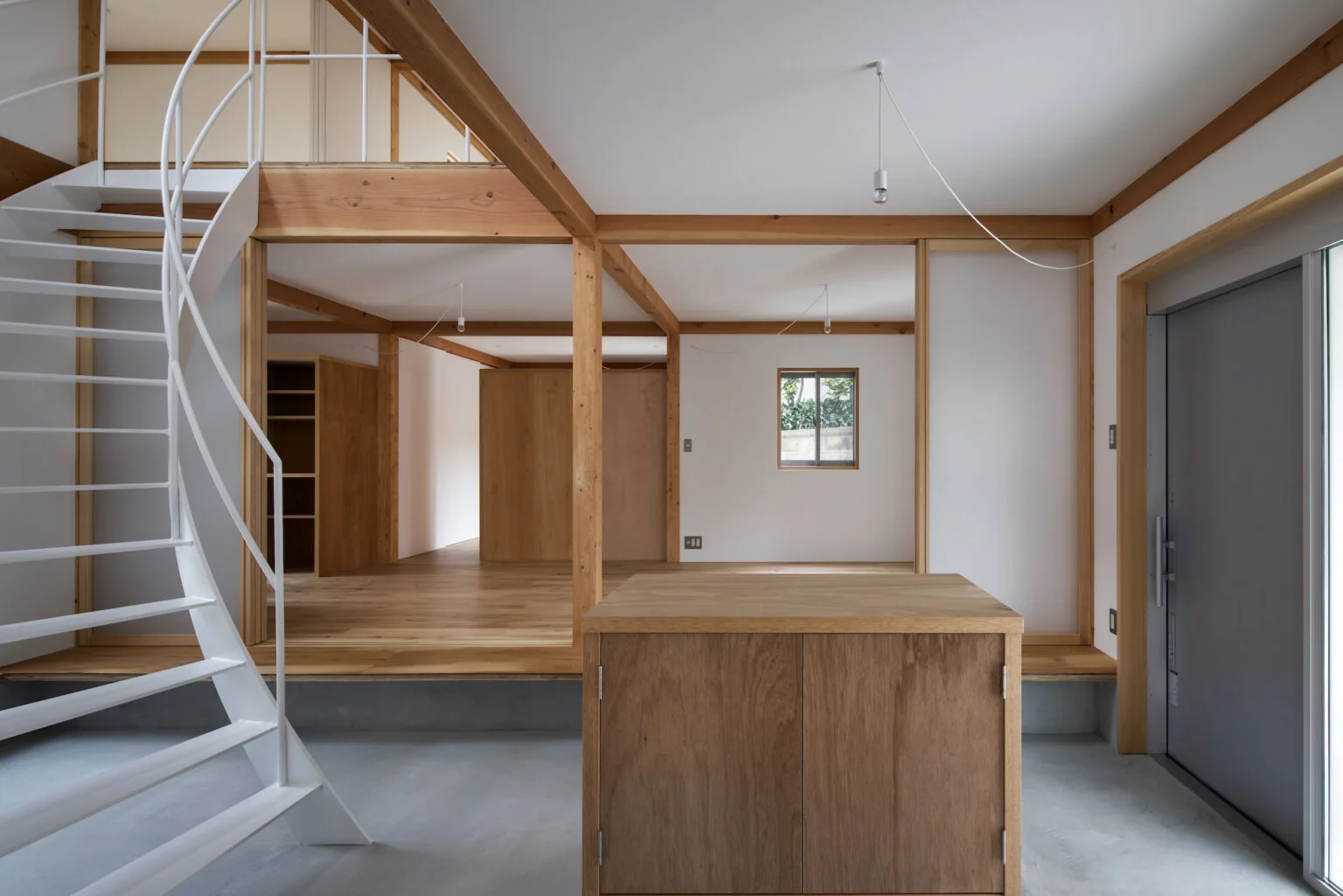
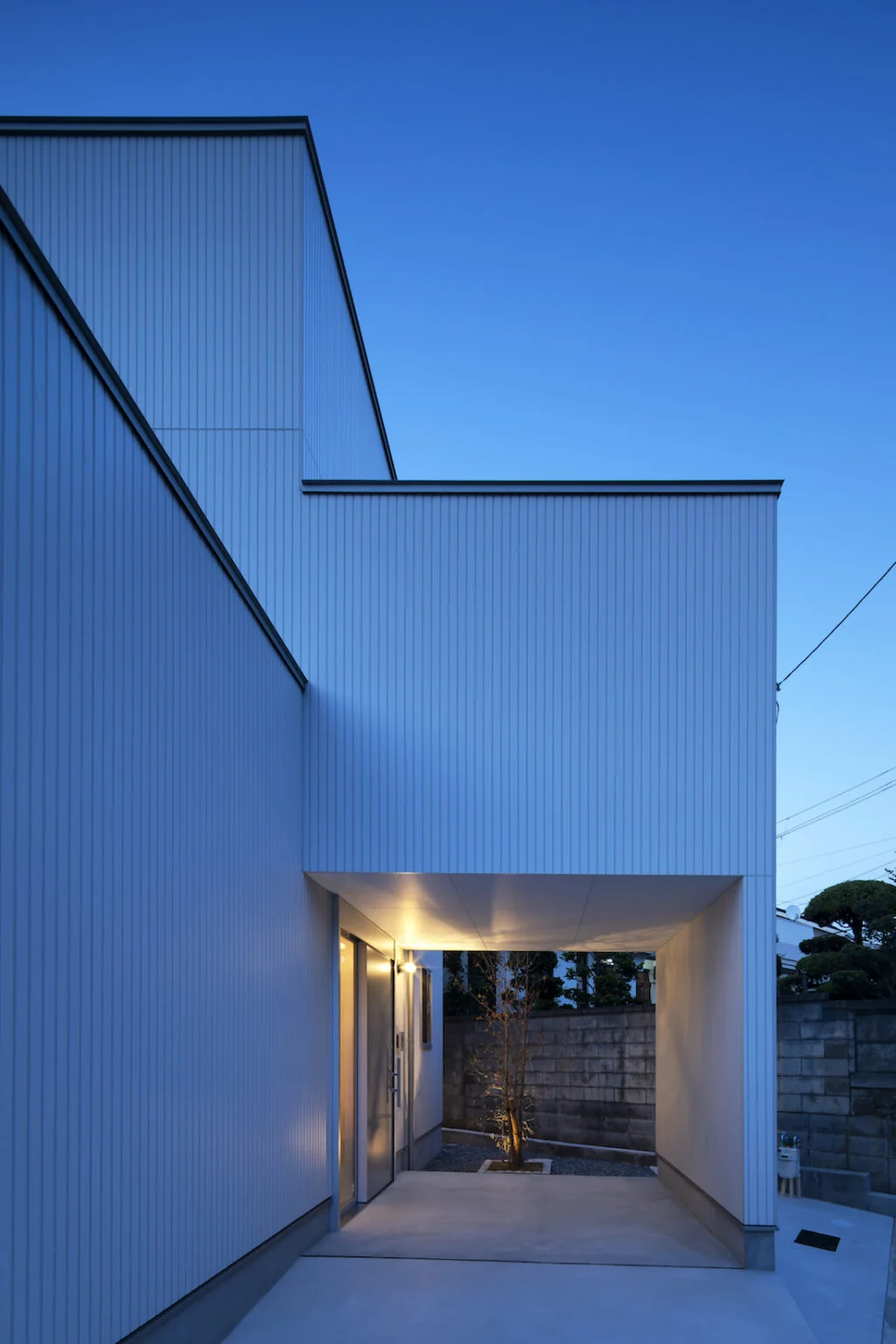
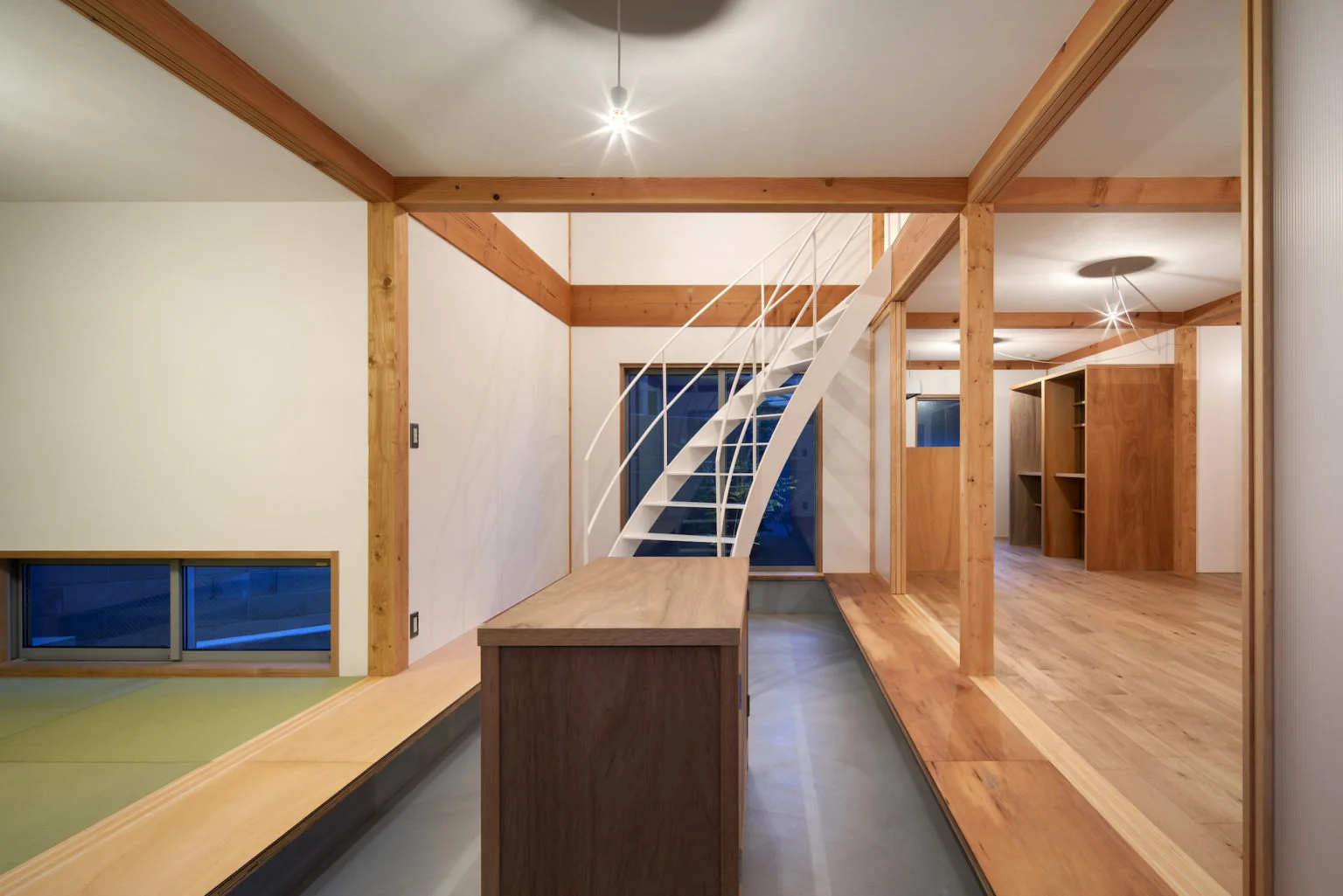
Semi-public earthen floor space that can accommodate casual visitors when the door is closed.
House with Slanted Lattice
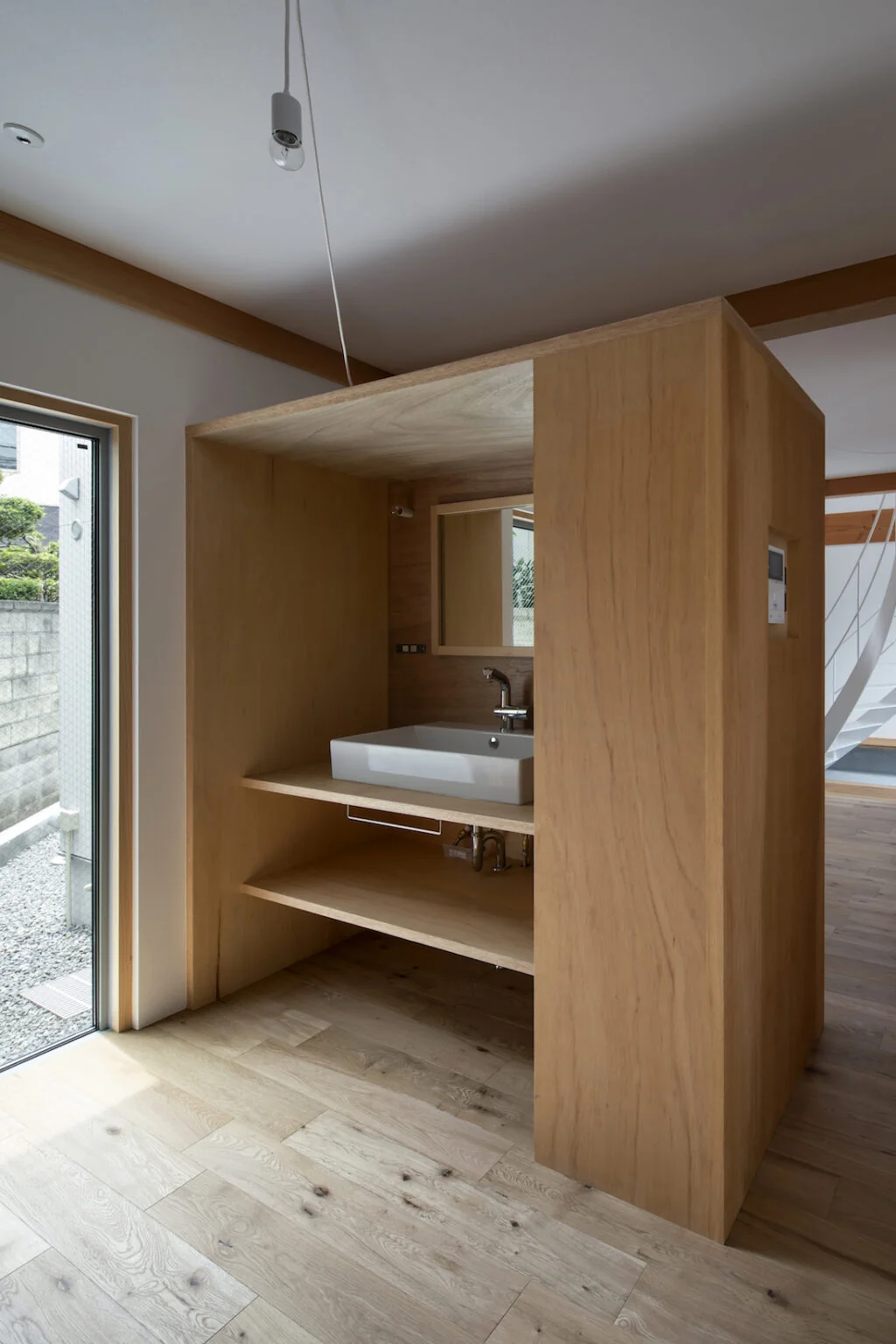
Custom-built washbasin resembling freestanding furniture.
House with Slanted Lattice
Japanese Modern
Natural Light
Steel Staircase
Breezy House
Exposed Beam
Passage Doma
Tsubo Garden
House with Doma
Irregular Site
Void
Eiji Tomita Photography Studio
Learn More
This is a reconstruction project for a homeowner and family who have decided to return to the family home in order to inherit land that has been lived on and cared for by successive generations. The site is located in a dense area where traditional houses and temples coexist and where numerous narrow alleyways—some approximately 1 m wide—are found nearby.
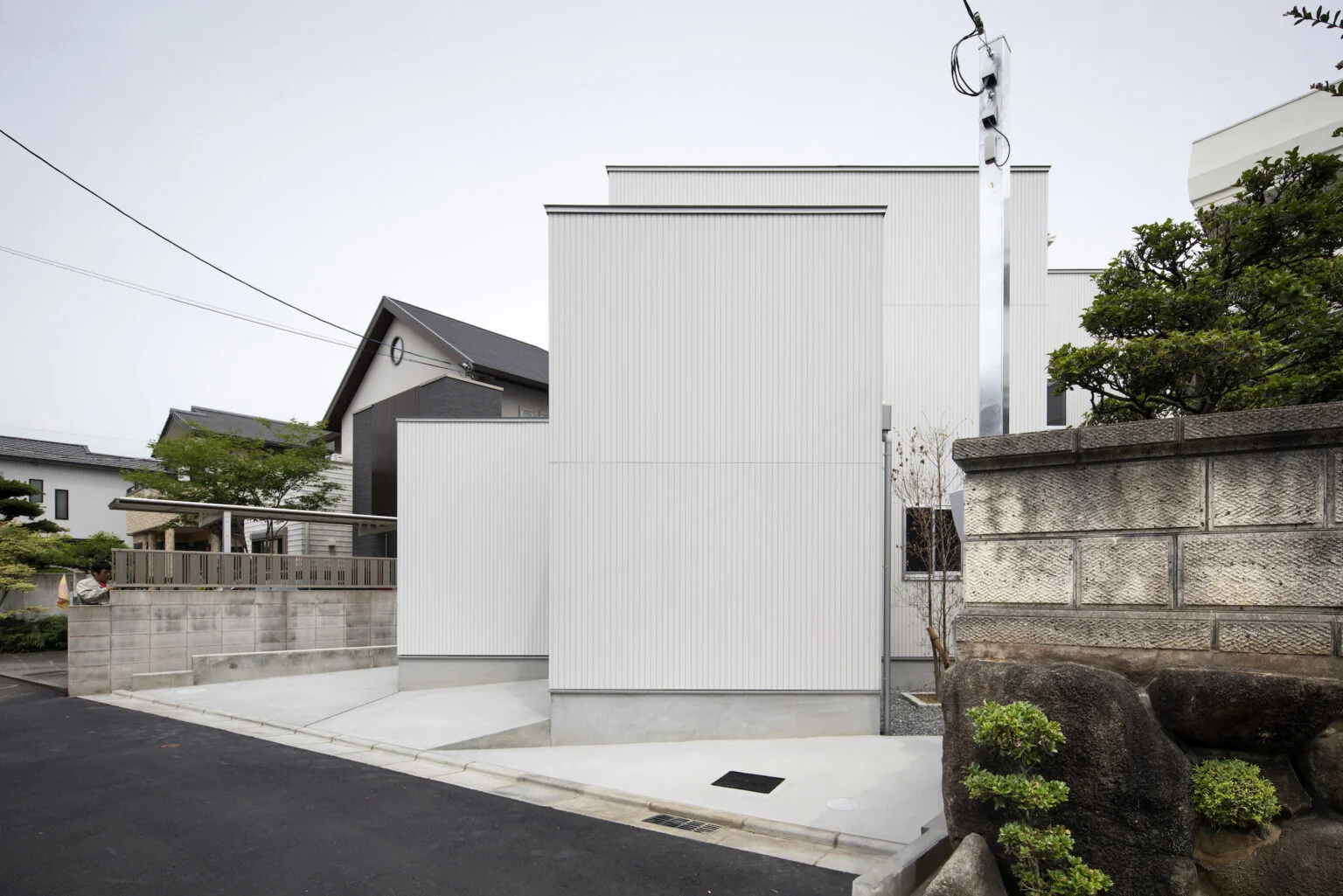
The street to the south is narrow, approximately 1.8 m wide, yet functions as a primary local circulation route; especially during the day vehicular and pedestrian traffic is frequent, creating an unsettled environment. To the east and north, adjacent lots are L-shaped parcels on higher ground, where buildings and walls follow the natural topography and enclose the subject site, producing a strong sense of enclosure.
At the same time, it was striking that a dense, long-established community still exists there. The client spent childhood within that community, and for a family in the child-rearing generation it represents a favorable living environment.
However, there was concern that, unless care were taken to accommodate generational differences associated with an aging community and the needs of a family newly joining the neighborhood, this traditional social fabric could give rise to negative elements often embedded within it—such as social entanglements and exhaustion.
From the standpoint of opening the house to the neighborhood, and within a dense context that tends to close inward, the design sought a stance that does not reject the traditional community but instead explores ways to maintain appropriate gaps and a sense of distance toward the surroundings, including psychological effects.
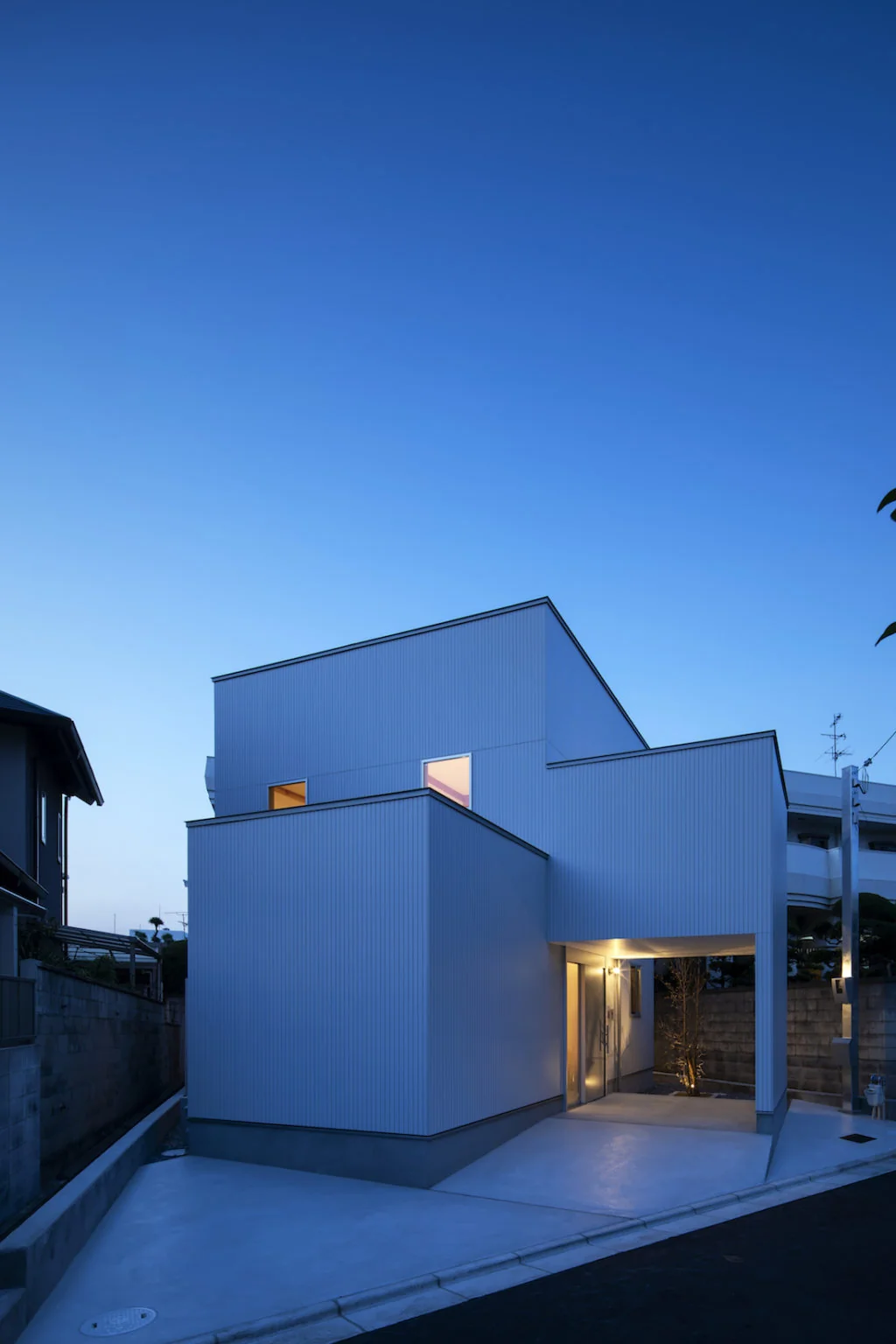
By planning the entire building along a 1.5-ken square grid rotated obliquely to the site, the plan becomes indented and produces several triangular voids along the perimeter. The multifaceted plan allows openings to be oriented in multiple directions, and the gaps function as sun pockets and wind wells, resulting in daylighting and ventilation conditions unusually generous for a dense lot.
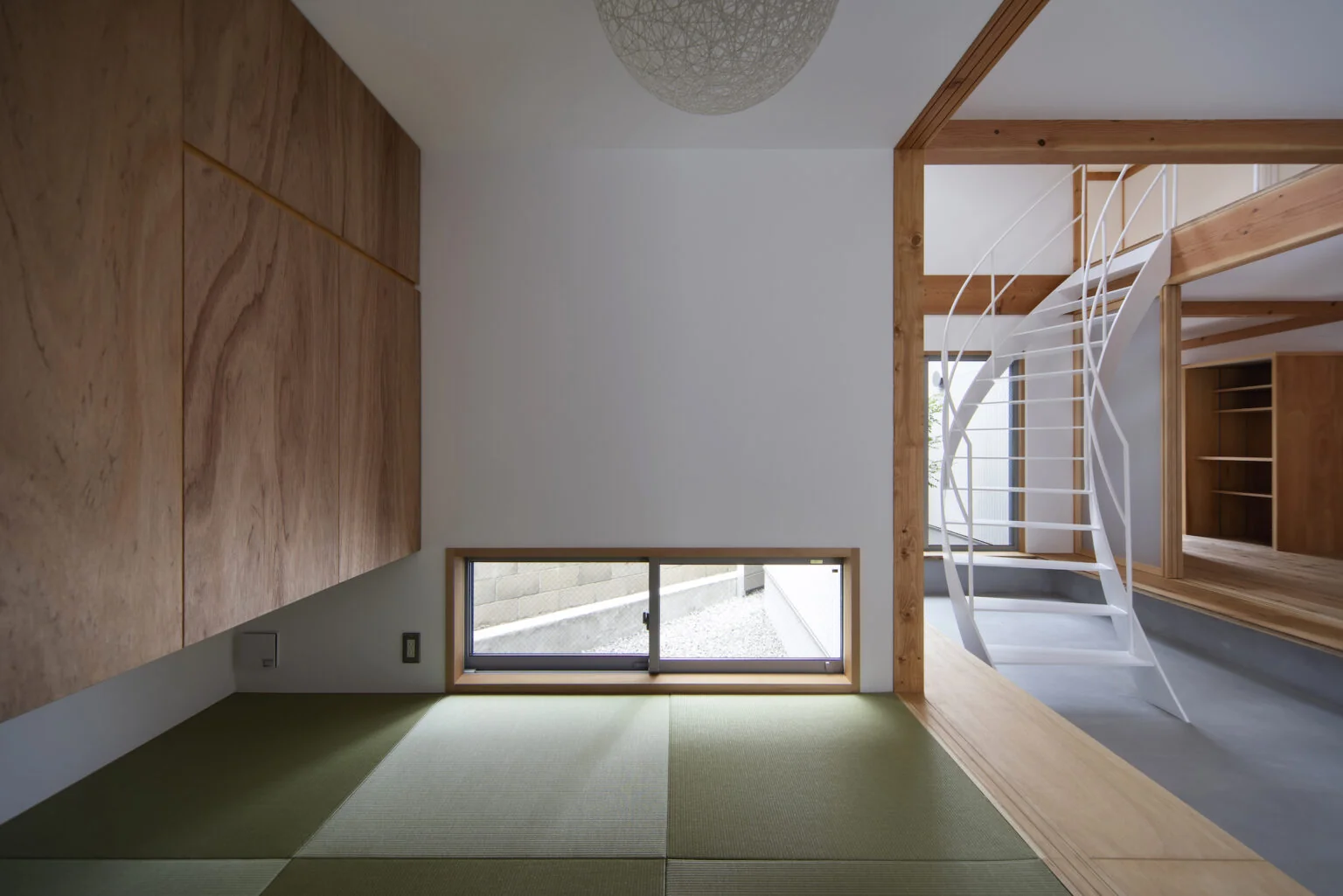
Openings are arranged so that they do not face directly toward neighboring openings but meet them obliquely, an intentional measure to create a psychological distance greater than the actual physical separation.
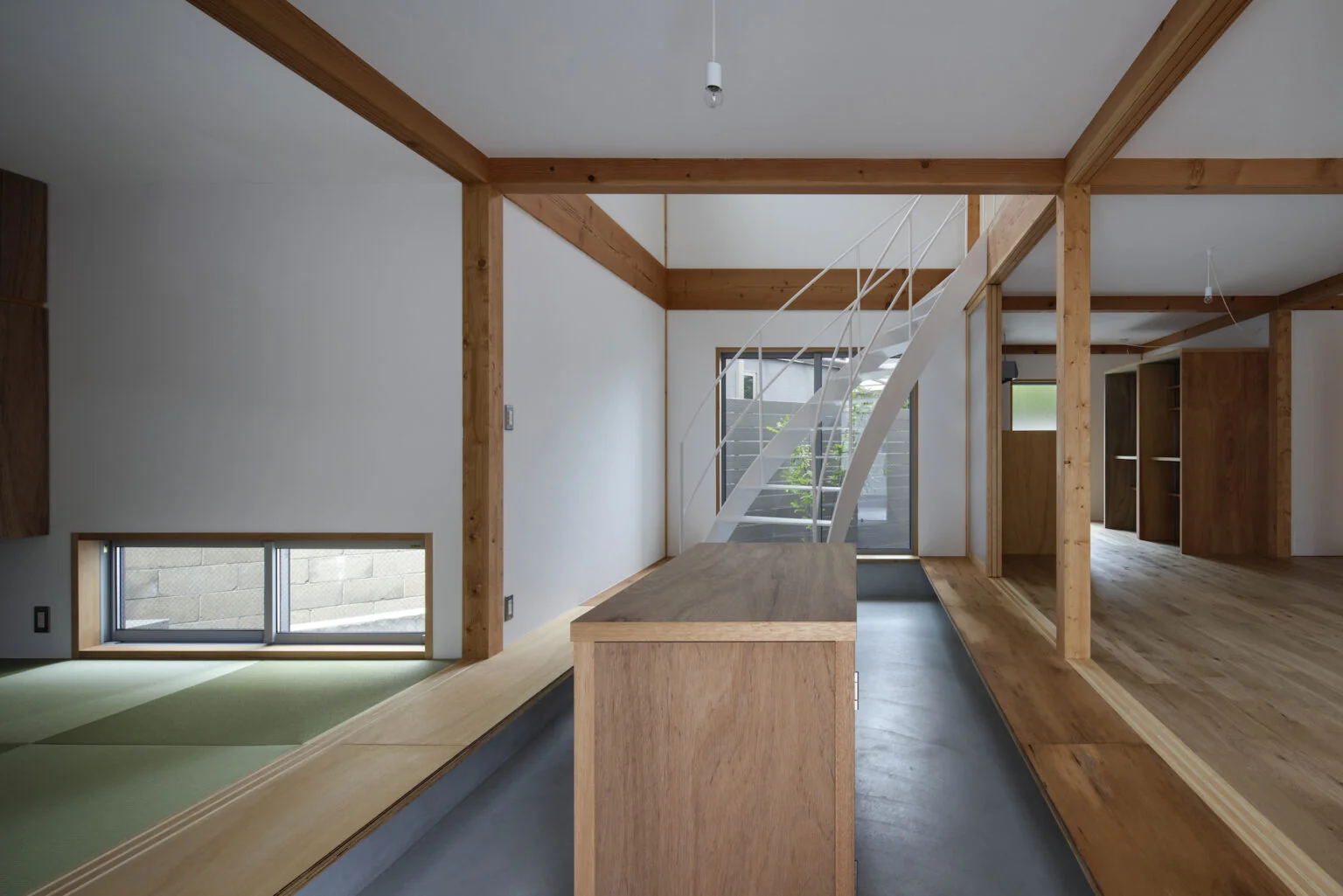
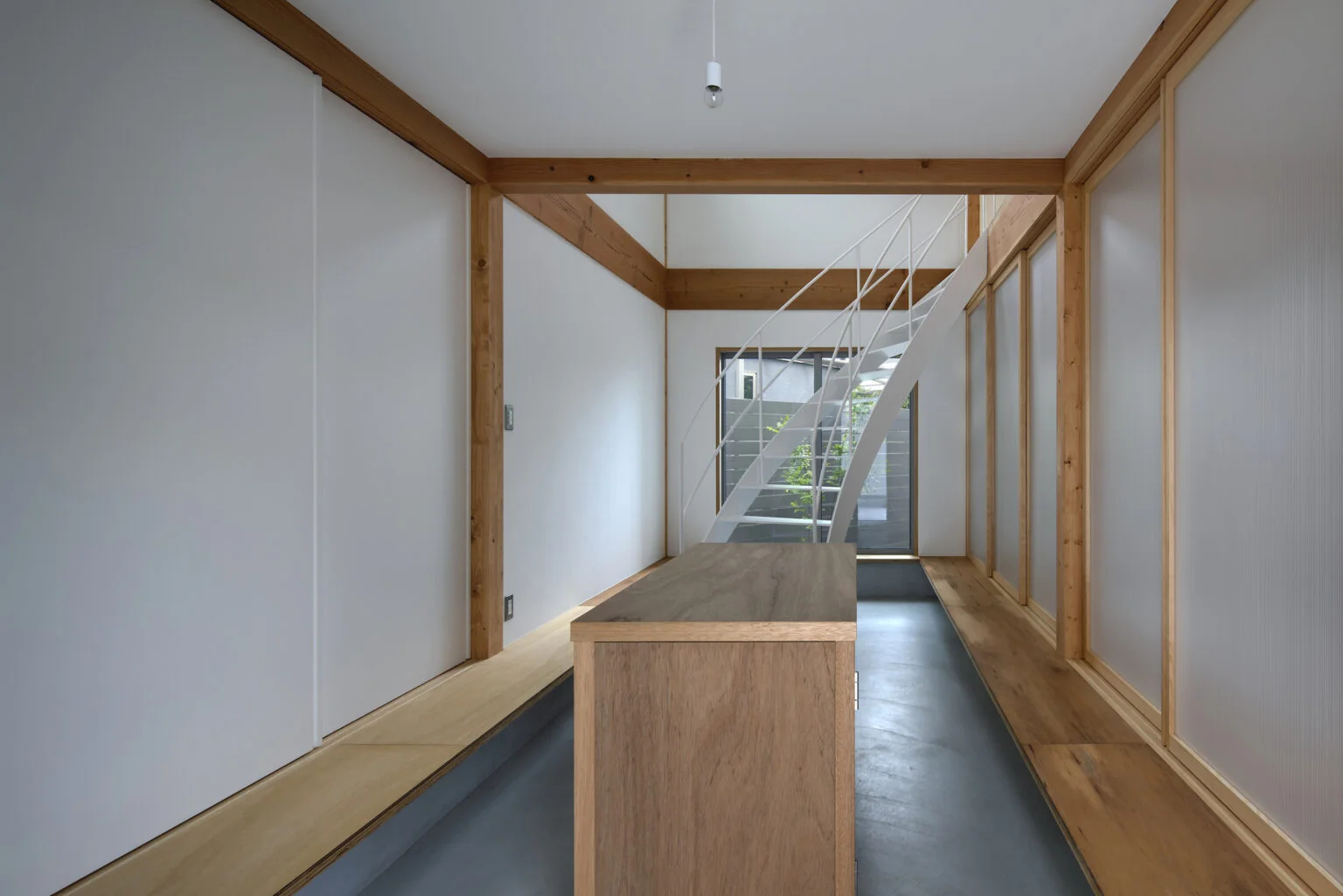
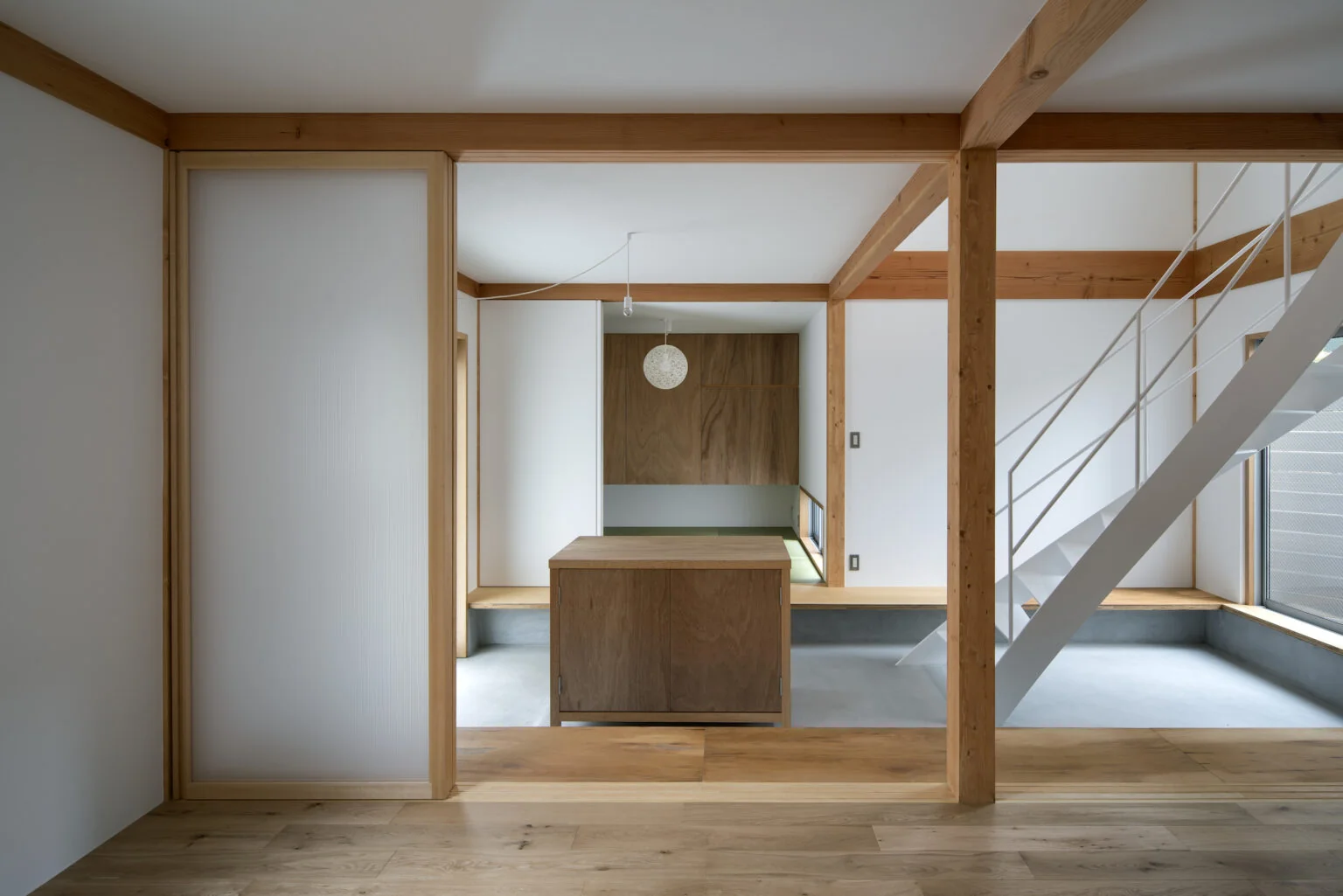
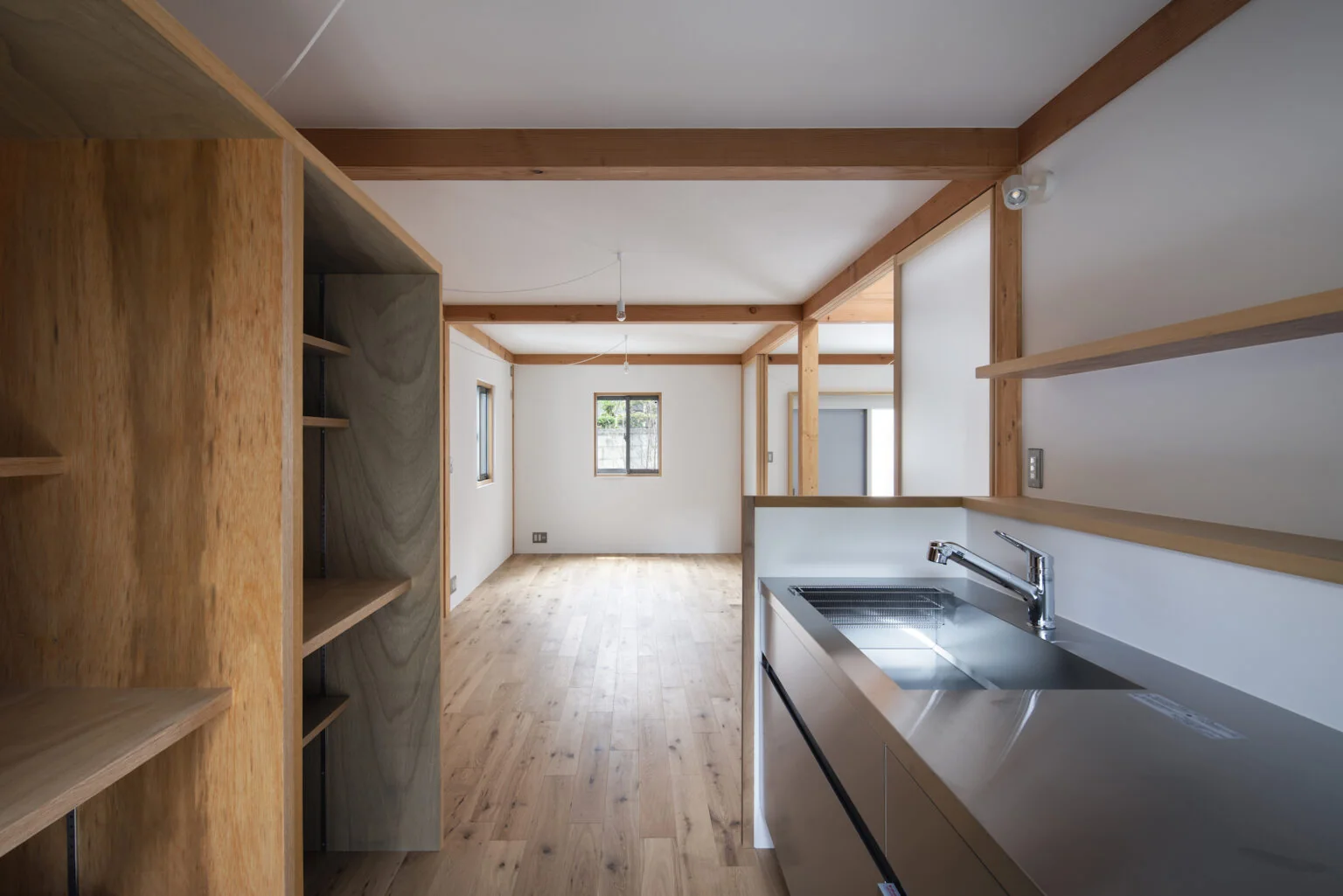
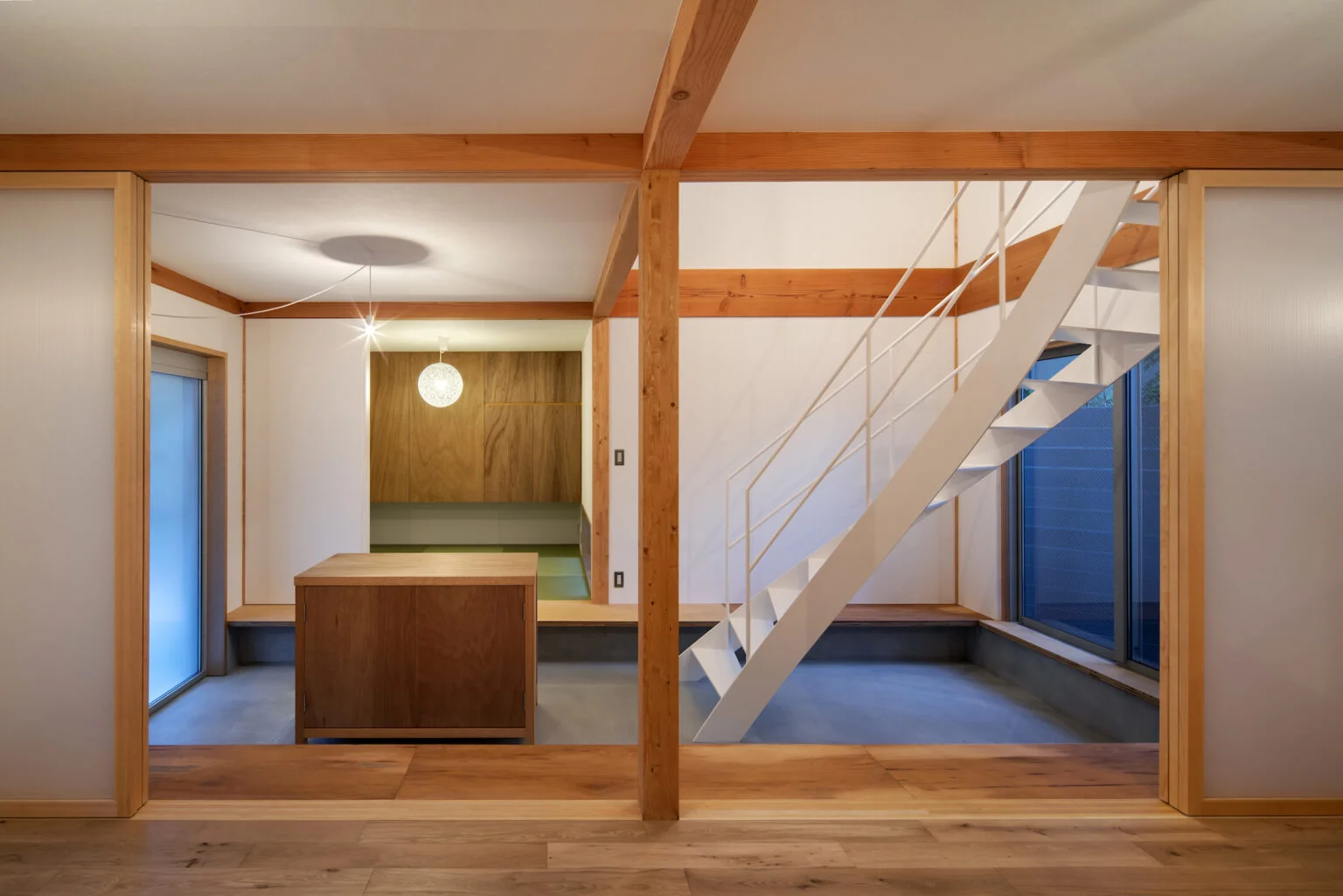
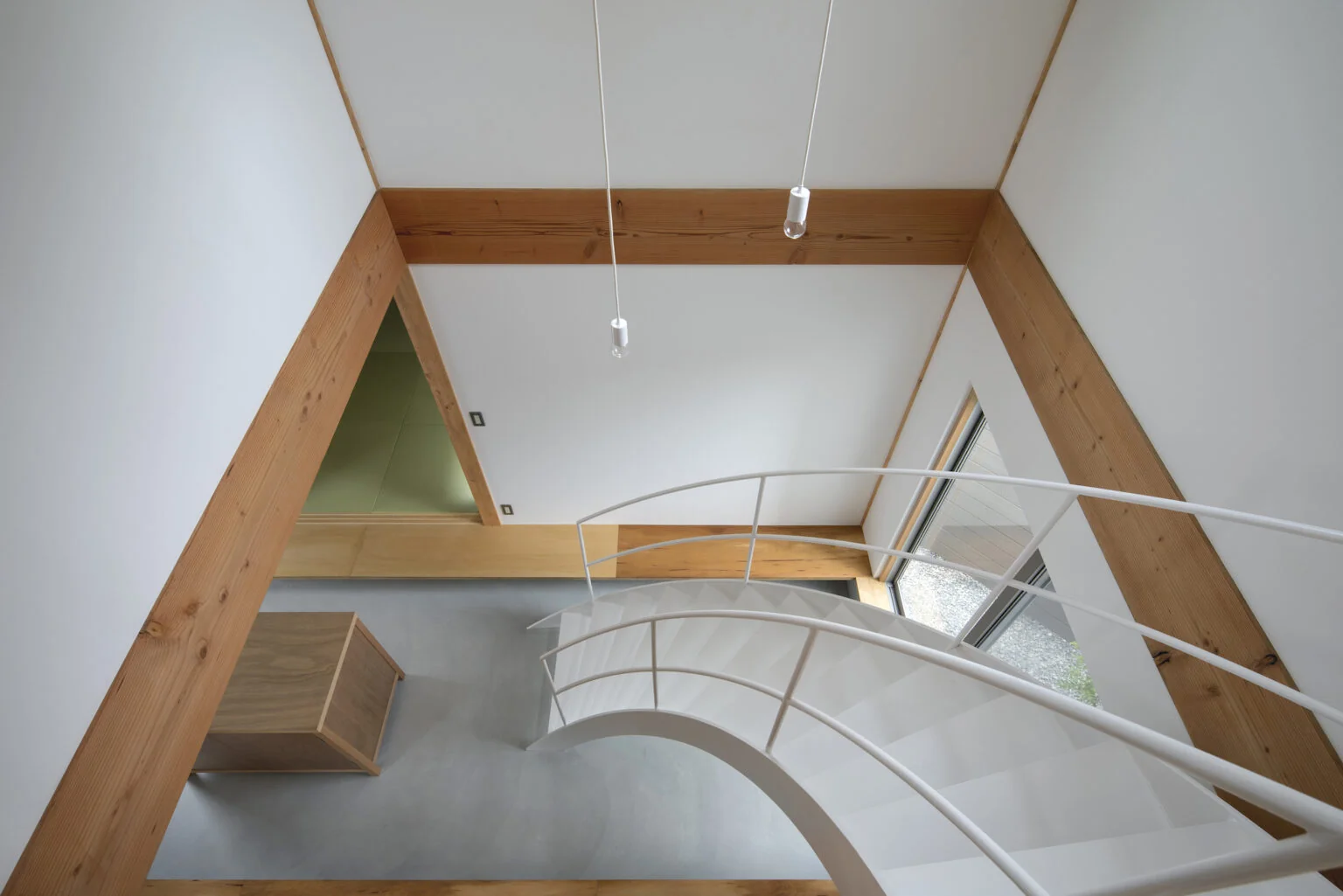
The interior employs a shinkabe (exposed-post-and-beam) structure articulated on a 1.5-ken grid. Because each grid cell is emphasized, the spaces acquire a strong directional quality, and prescribed sightlines terminate in oblique exterior views.
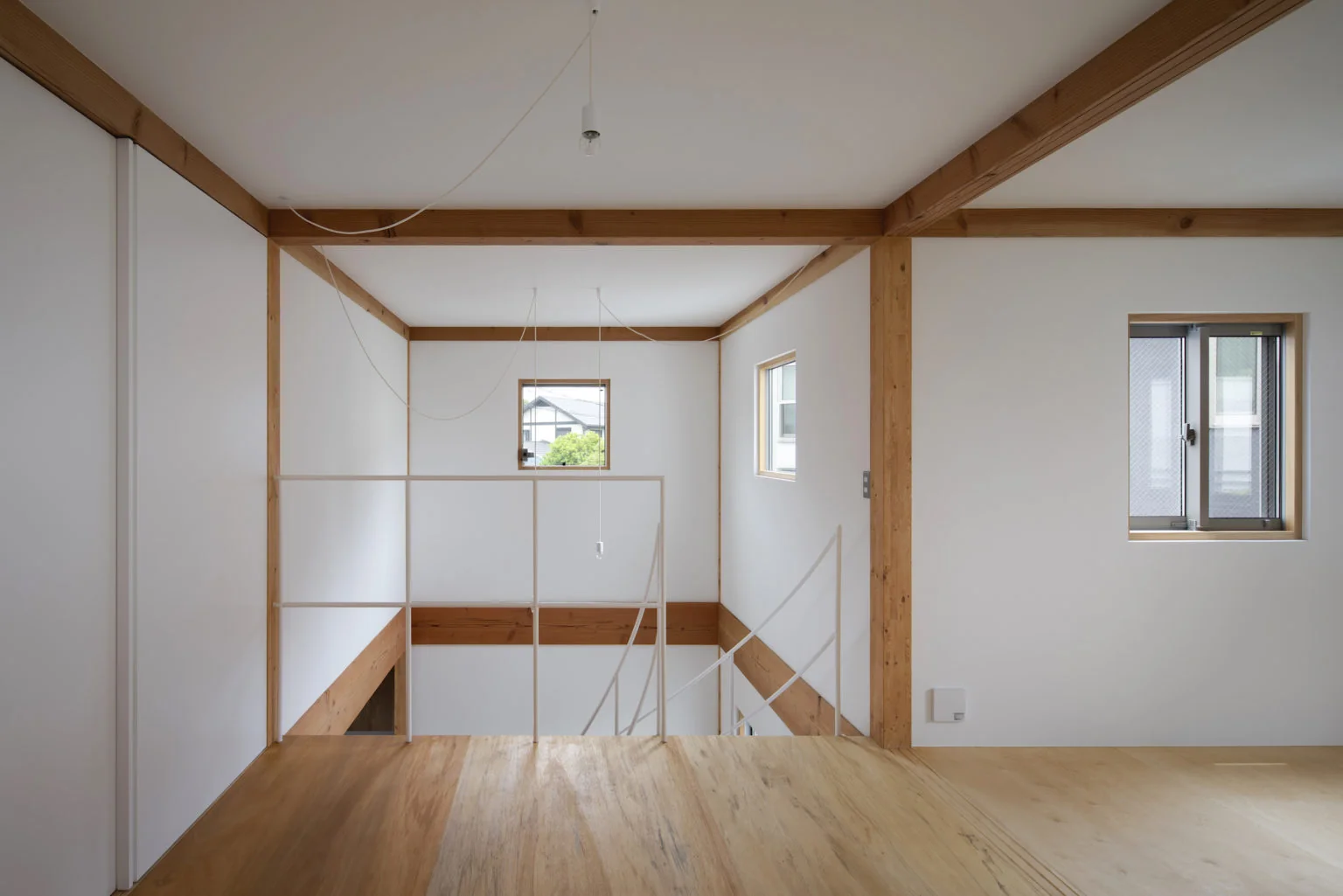
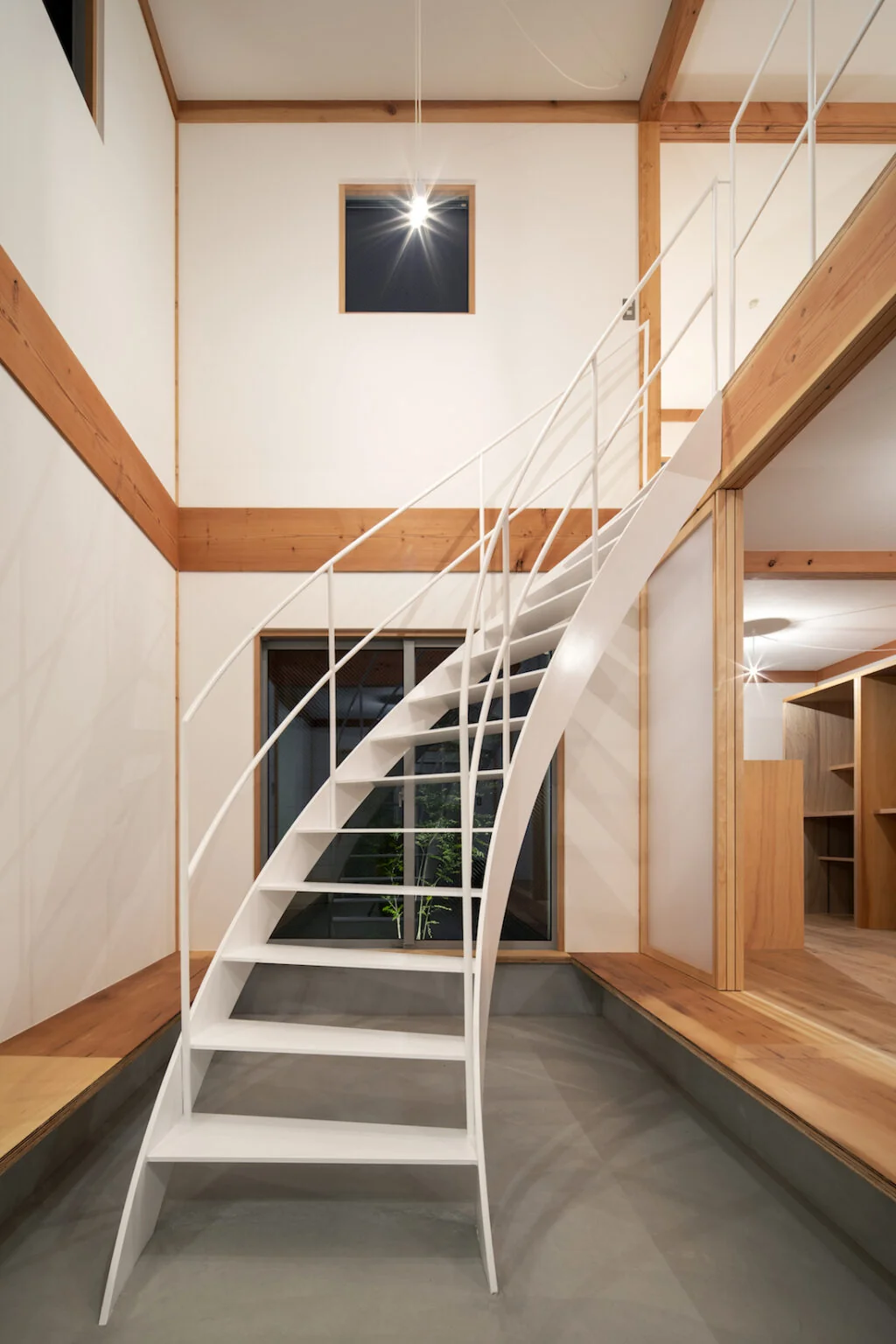
The staircase is shaped as a 90° sector so that, during vertical movement, the line of sight is rotated 90° in a spiraling manner. This spatial sequence produces a sensation in occupants of reduced orientation with respect to the outside—their awareness of where they are on the site and which way they are facing becomes attenuated. By diminishing the perception of positional relationships to the exterior, immersion within the interior is increased, and, as a result, awareness of the outside—and the attendant tension of feeling observed—may be alleviated.
Although the building’s form, derived from these constraints, may at first appear unconventional, it has become a familiar, comfortable home that nonetheless evokes a sense of nostalgia. It is hoped that this new dwelling, established on land inherited through generations, will itself be passed on to future generations with affection. Location: Osaka Prefecture, Japan
Primary use: Residential (private dwelling)
Structure: Timber-framed, two-storey building
Builder: Kosuge Construction Co., Ltd.

The street to the south is narrow, approximately 1.8 m wide, yet functions as a primary local circulation route; especially during the day vehicular and pedestrian traffic is frequent, creating an unsettled environment. To the east and north, adjacent lots are L-shaped parcels on higher ground, where buildings and walls follow the natural topography and enclose the subject site, producing a strong sense of enclosure.
At the same time, it was striking that a dense, long-established community still exists there. The client spent childhood within that community, and for a family in the child-rearing generation it represents a favorable living environment.
However, there was concern that, unless care were taken to accommodate generational differences associated with an aging community and the needs of a family newly joining the neighborhood, this traditional social fabric could give rise to negative elements often embedded within it—such as social entanglements and exhaustion.
From the standpoint of opening the house to the neighborhood, and within a dense context that tends to close inward, the design sought a stance that does not reject the traditional community but instead explores ways to maintain appropriate gaps and a sense of distance toward the surroundings, including psychological effects.
By planning the entire building along a 1.5-ken square grid rotated obliquely to the site, the plan becomes indented and produces several triangular voids along the perimeter. The multifaceted plan allows openings to be oriented in multiple directions, and the gaps function as sun pockets and wind wells, resulting in daylighting and ventilation conditions unusually generous for a dense lot.
Openings are arranged so that they do not face directly toward neighboring openings but meet them obliquely, an intentional measure to create a psychological distance greater than the actual physical separation.
The interior employs a shinkabe (exposed-post-and-beam) structure articulated on a 1.5-ken grid. Because each grid cell is emphasized, the spaces acquire a strong directional quality, and prescribed sightlines terminate in oblique exterior views.
The staircase is shaped as a 90° sector so that, during vertical movement, the line of sight is rotated 90° in a spiraling manner. This spatial sequence produces a sensation in occupants of reduced orientation with respect to the outside—their awareness of where they are on the site and which way they are facing becomes attenuated. By diminishing the perception of positional relationships to the exterior, immersion within the interior is increased, and, as a result, awareness of the outside—and the attendant tension of feeling observed—may be alleviated.
Although the building’s form, derived from these constraints, may at first appear unconventional, it has become a familiar, comfortable home that nonetheless evokes a sense of nostalgia. It is hoped that this new dwelling, established on land inherited through generations, will itself be passed on to future generations with affection. Location: Osaka Prefecture, Japan
Primary use: Residential (private dwelling)
Structure: Timber-framed, two-storey building
Builder: Kosuge Construction Co., Ltd.
- Copyright(C)Qurasuki.All Rights Reserved.