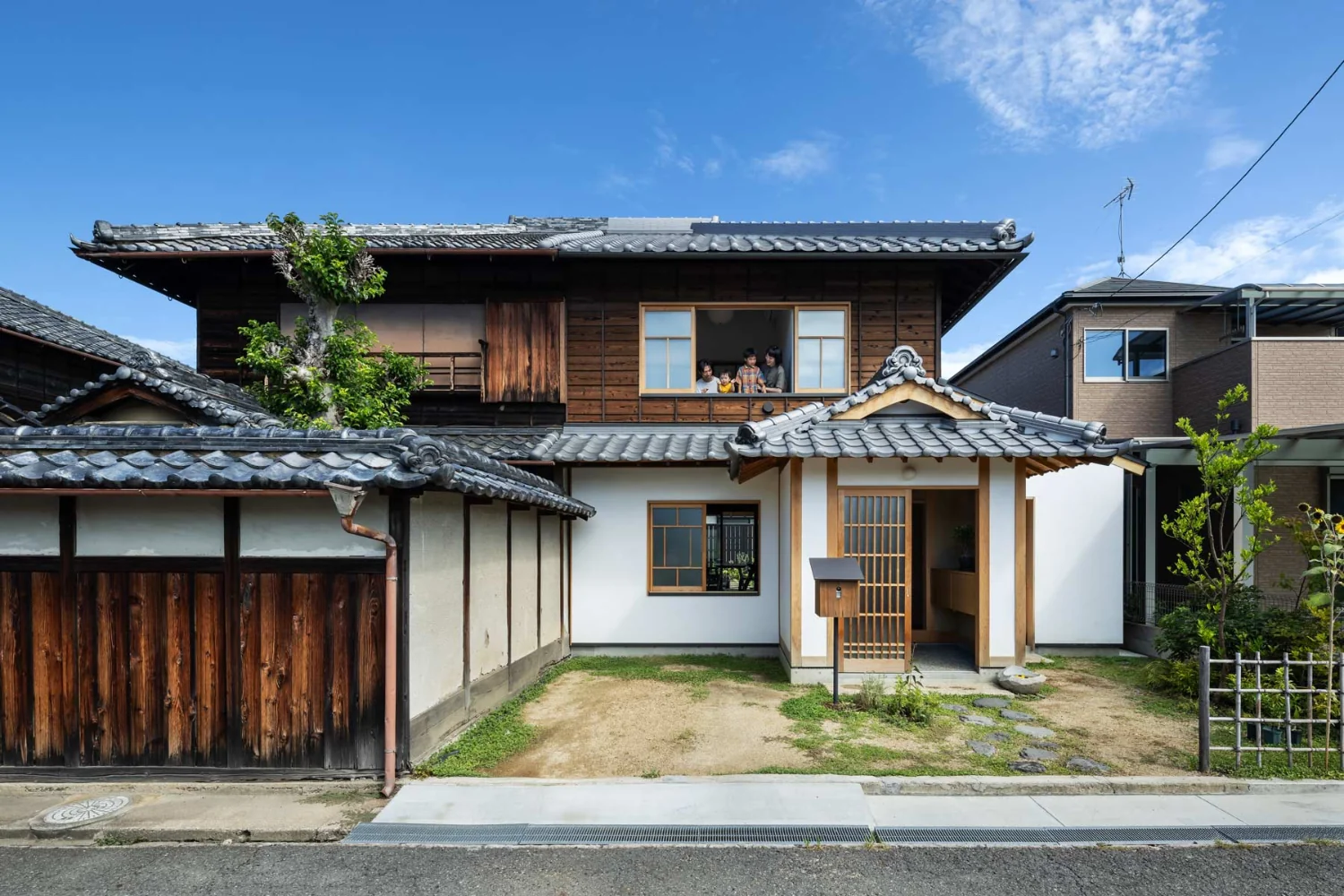
Introducing House of Weariness | Renovation of One Side of a Prewar Paired Row House, a custom-built home example by Yoshihiro Yamamoto Architects Associates, a Architect / Design office in 302, Zeniya Honpo Main Building, 14-6 Ishigatsujichō, Tennōji-ku, Osaka

Renovation of one side of a prewar paired row house
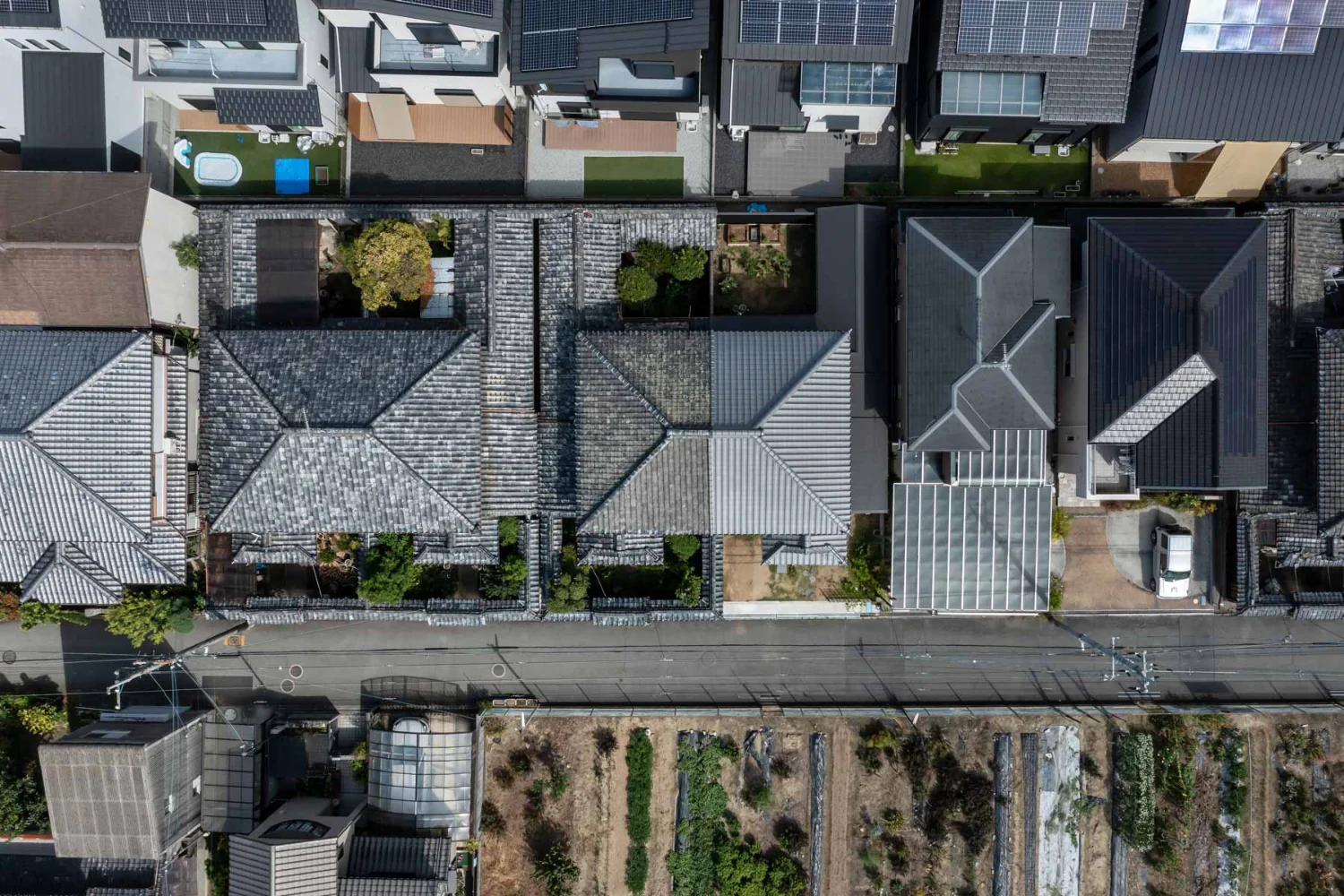
The decaying high fence was removed to expand the garden. The large roof had deteriorated tiles and soil removed and was re-roofed.
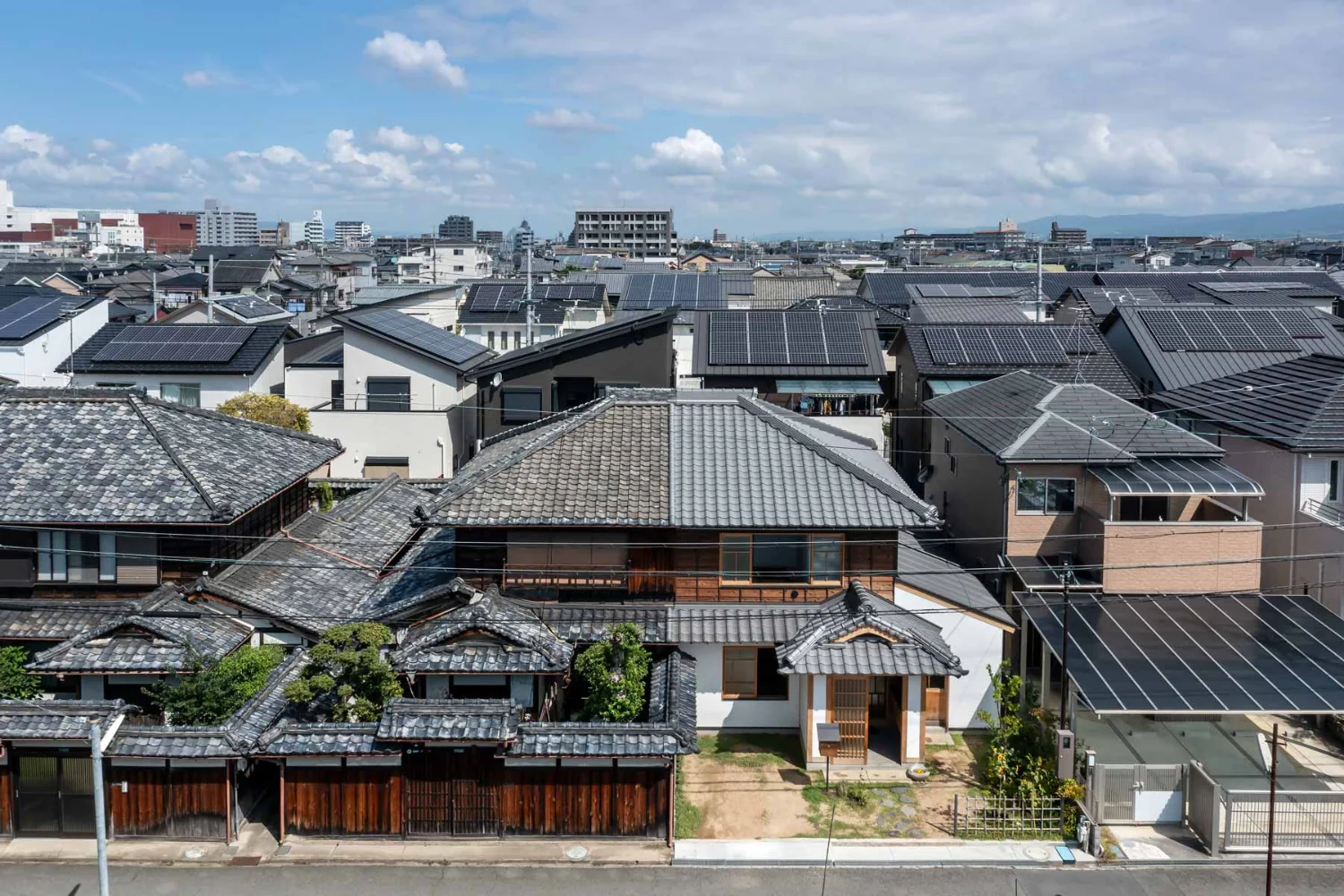
Only one side of a prewar two‑unit rental row house was renovated and transformed into a home for a young family.
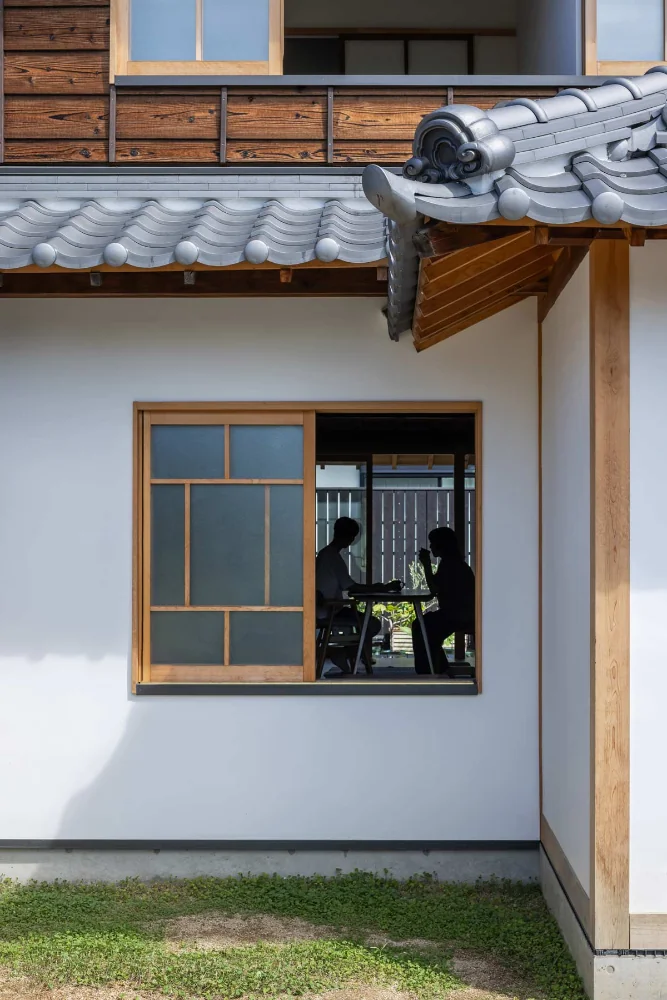
Otafuku-style windows retrofitted with double glazing, following the existing aesthetic. Sightlines extend to the garden beyond.
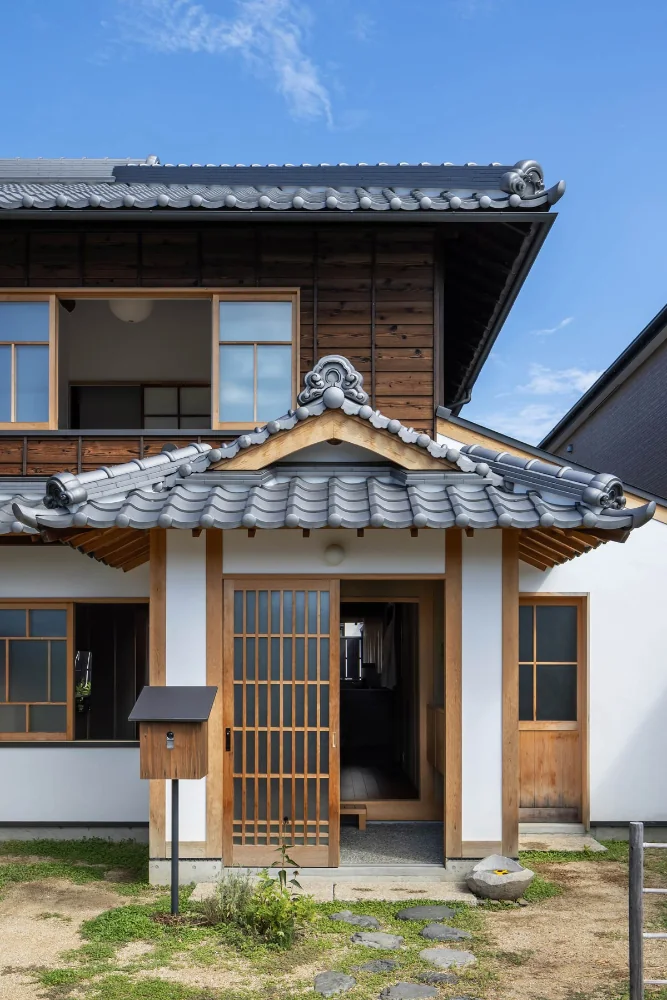
The entrance was entirely dismantled, a raft foundation cast, and deteriorated members renewed as the assembly was rebuilt with seismic strengthening.
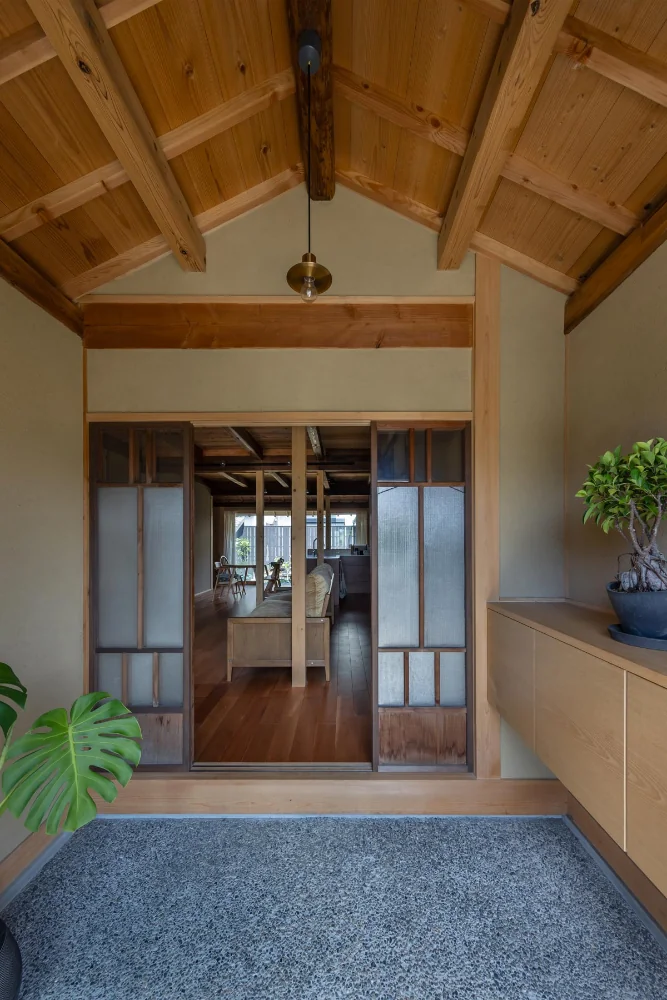
The reconstructed entrance. Joinery elements with severe damage were repaired and reused.
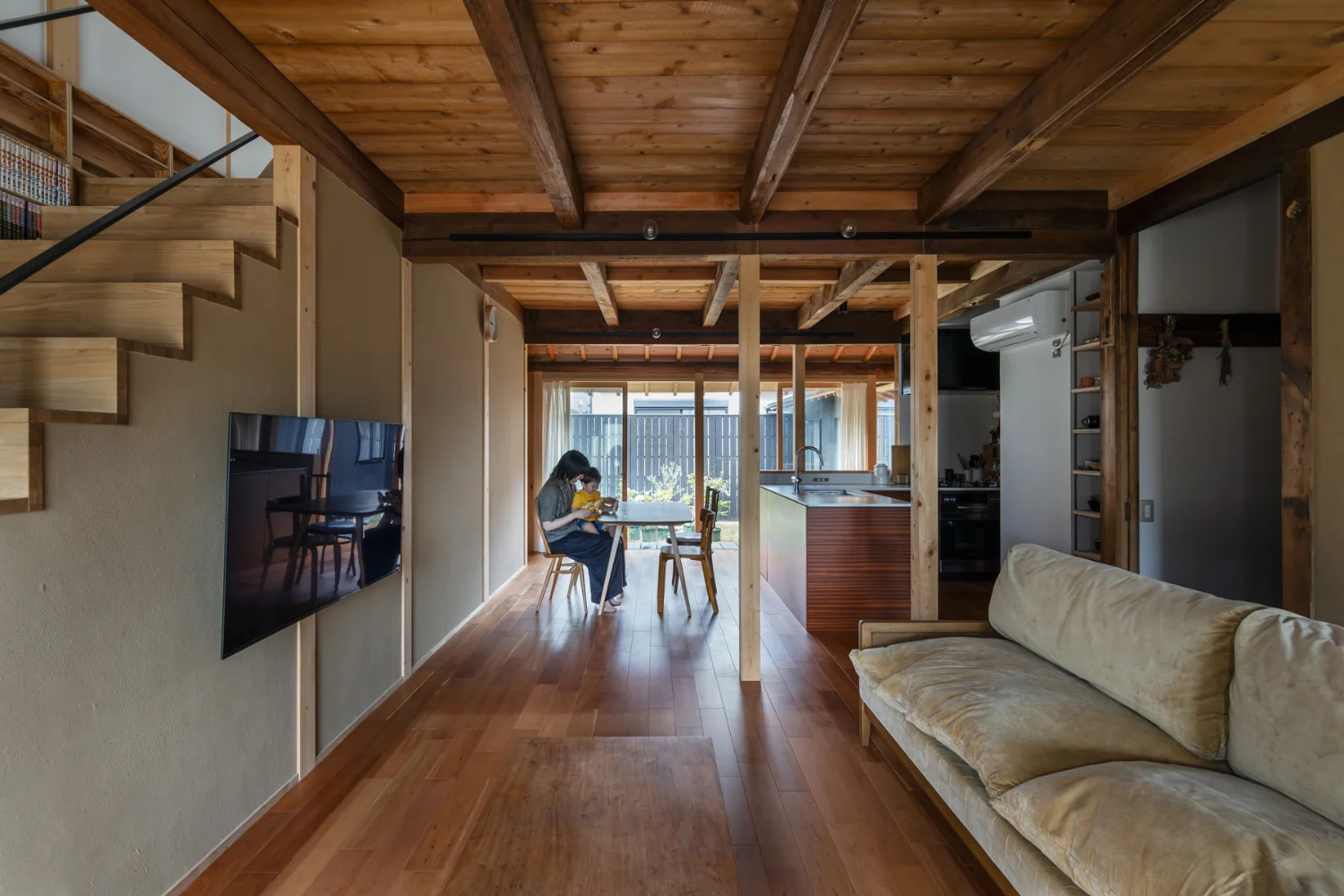
Overall view of the living room. The original structure was strengthened while a western-style room and two Japanese rooms were combined into a large single space.
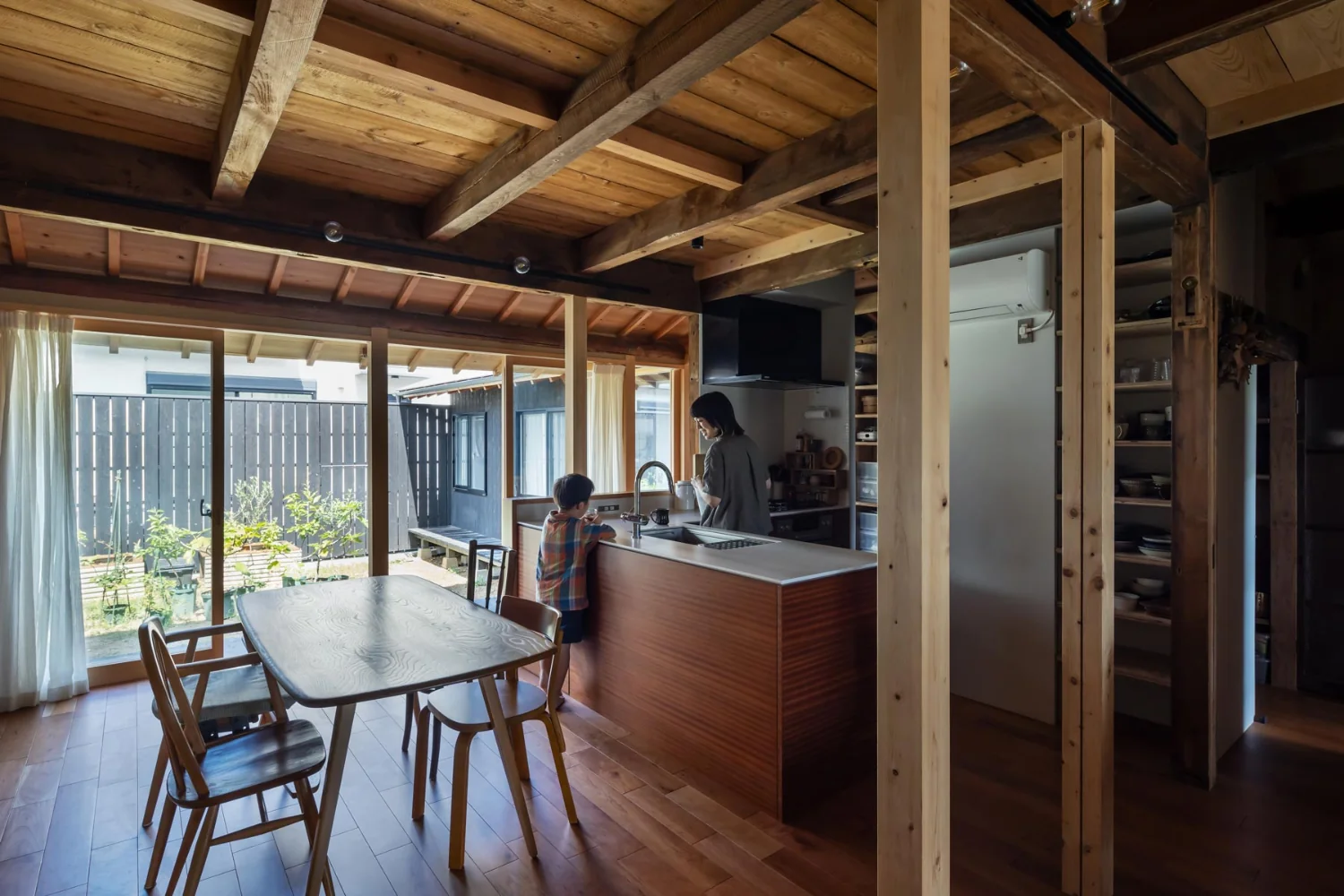
The kitchen was custom-built as an irregular L-shaped peninsula to suit the new layout.
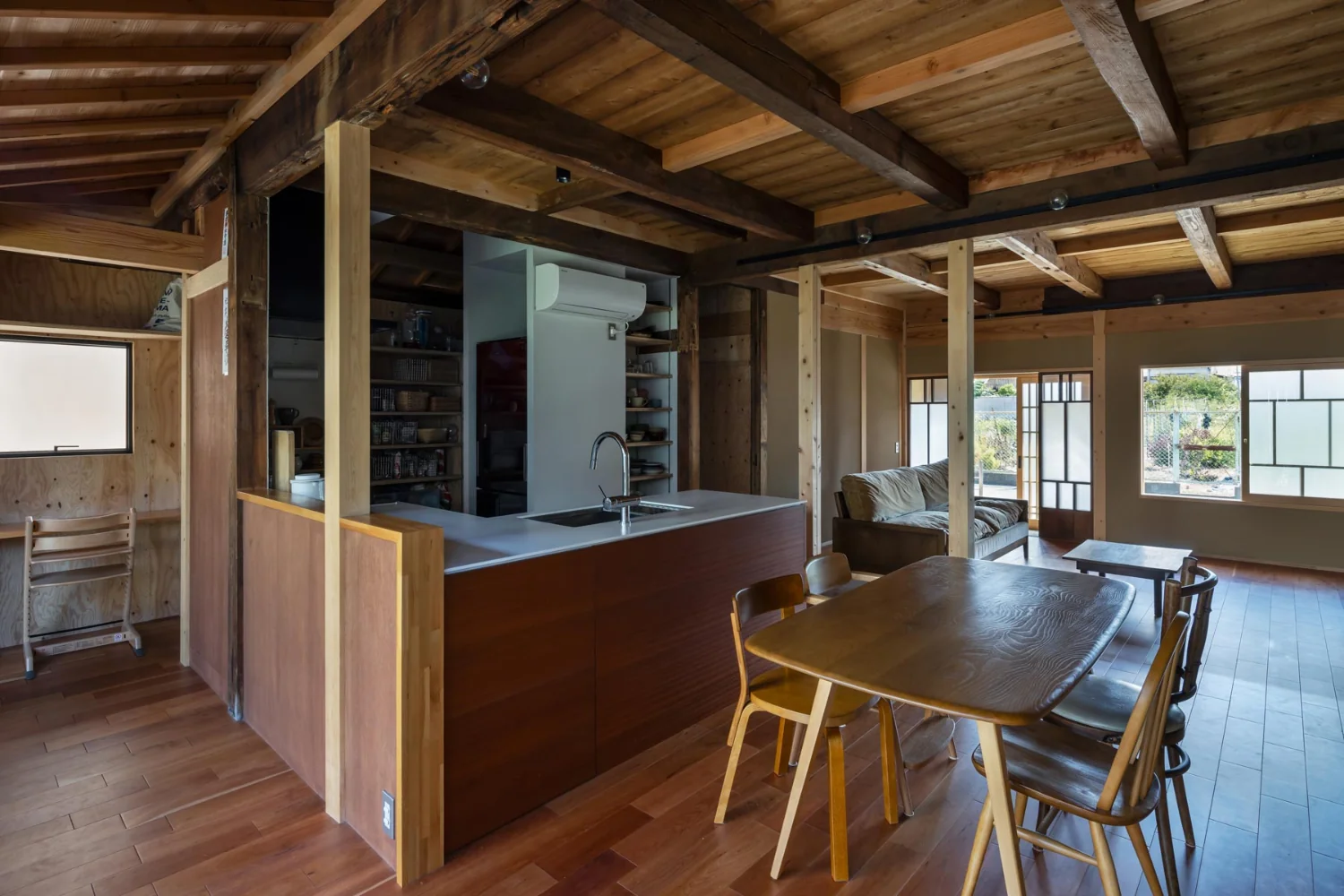
Double circulation — inside and outside the kitchen — provides flexible storage and domestic workflows with a highly adaptable plan.
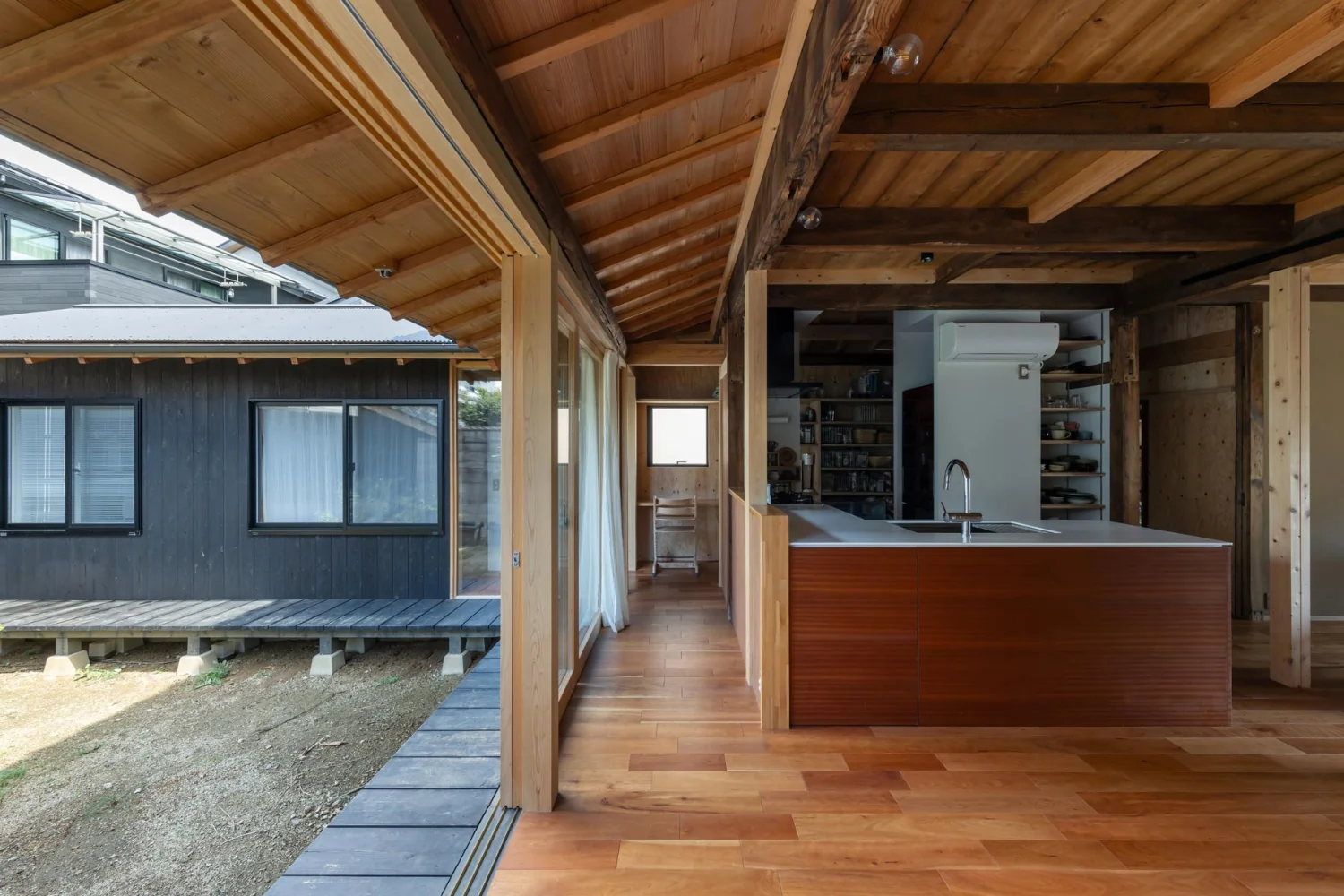
Connection from living room to engawa (verandah) to garden. The engawa also functions as a laundry drying area. The projecting volume contains the washroom and bathroom.
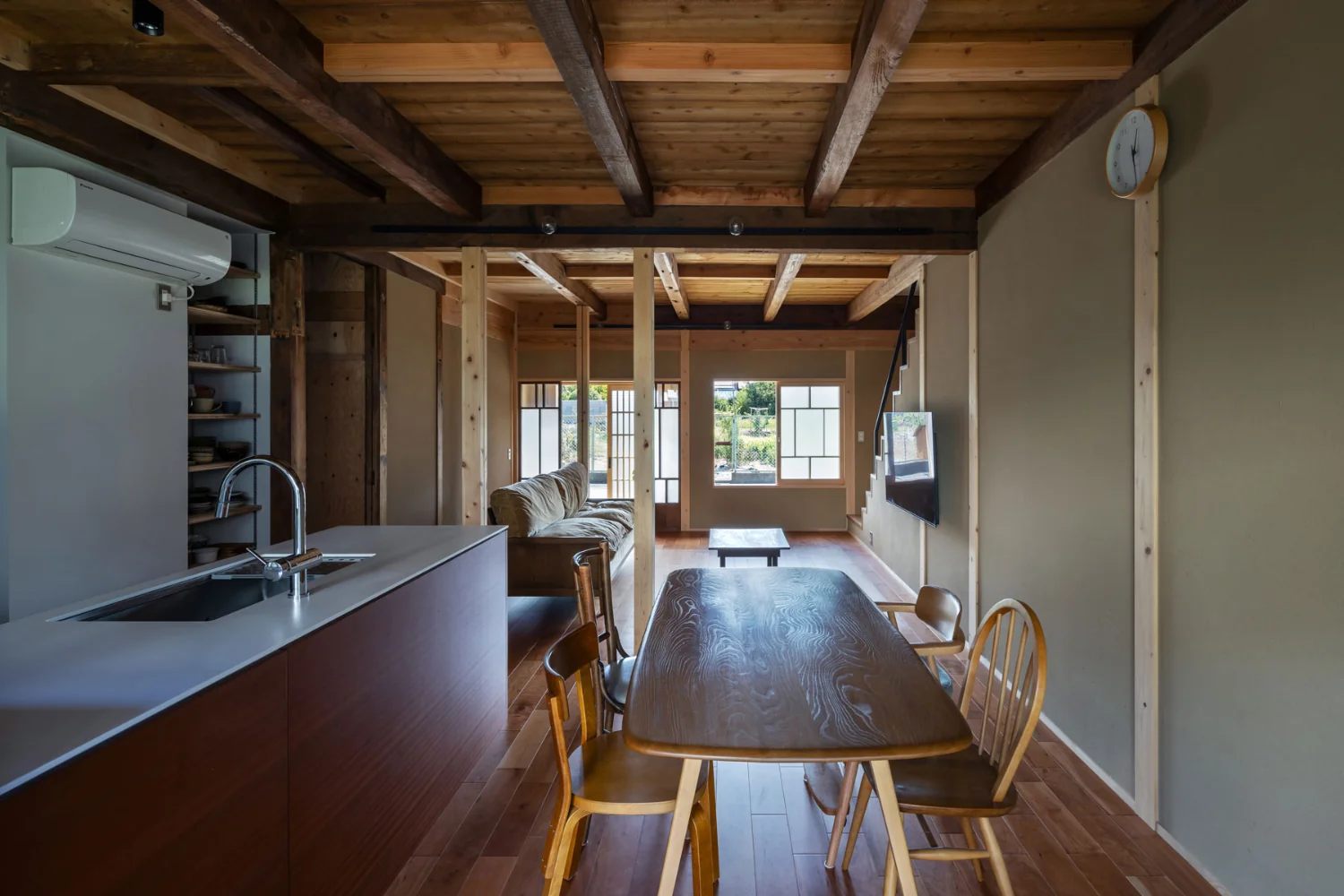
View from the dining area toward the entrance. Flooring is cherry; kitchen faces are sapele.
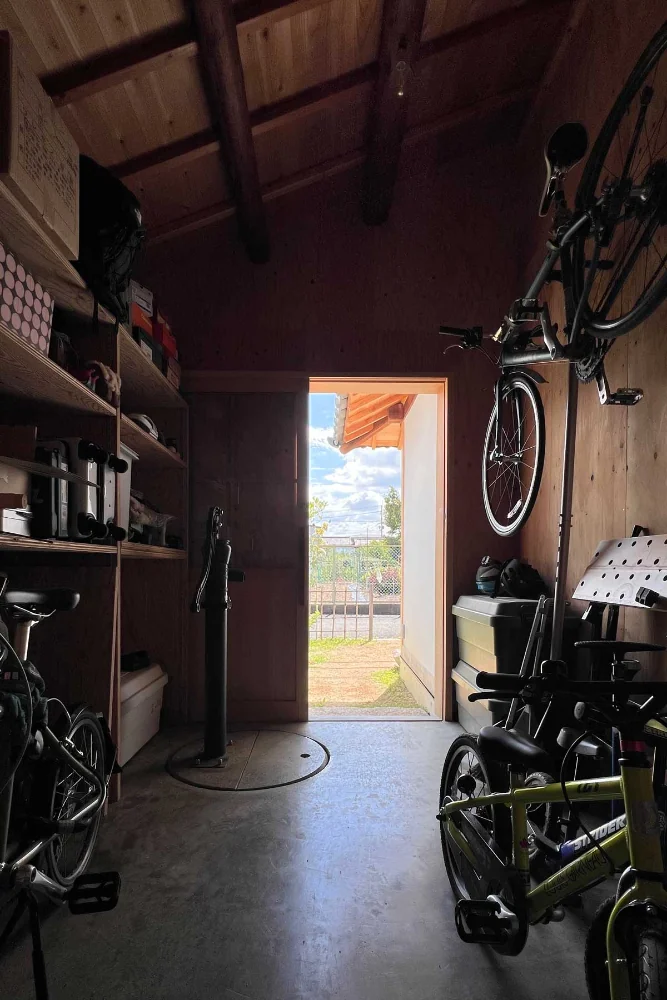
The family entrance with a doma (earthen-floored mudroom) that doubles as a storage room. A well discovered during demolition was refurbished and is used for irrigation.
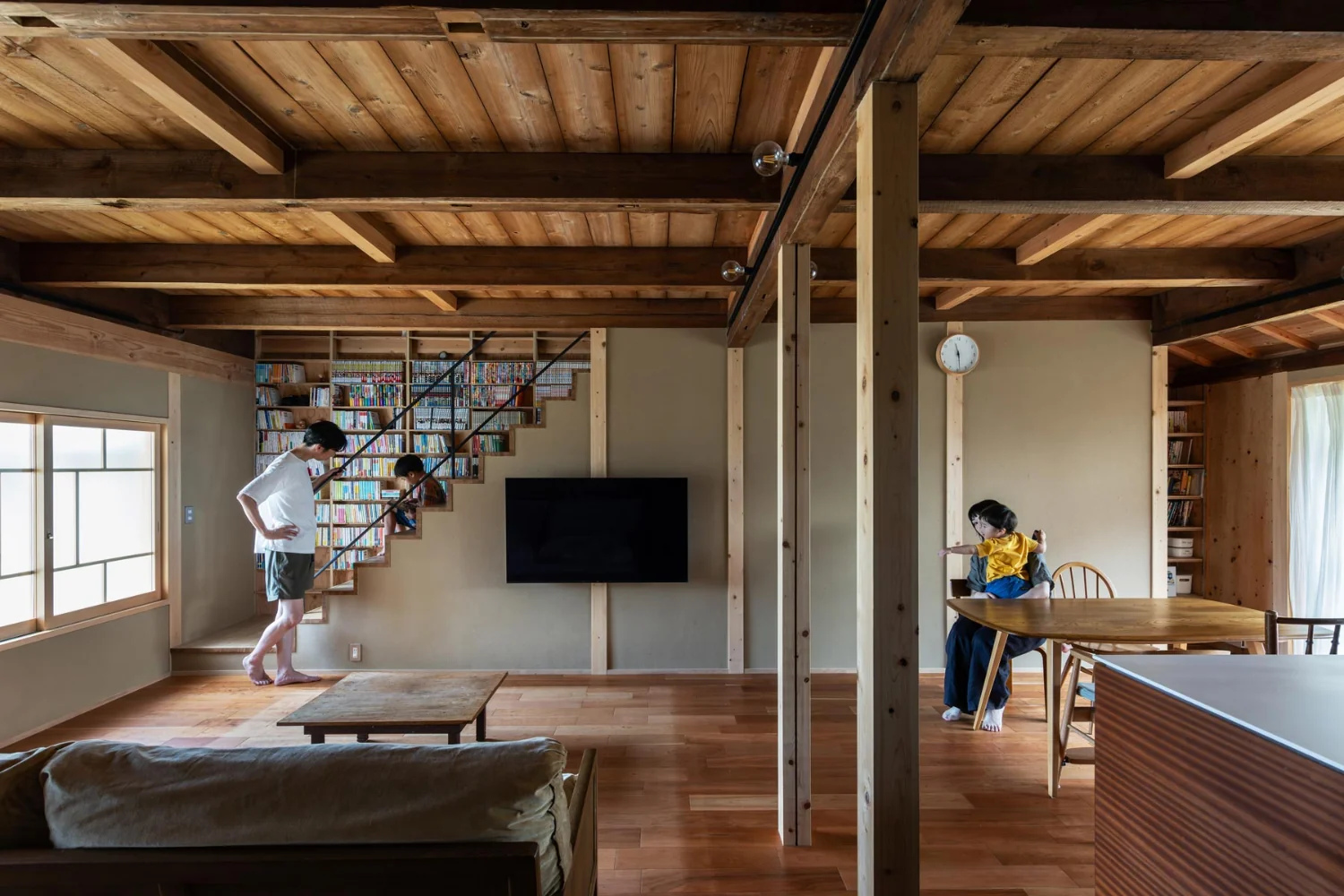
Above the stairs: an open, shallow-depth library for paperbacks, paperbacks and comics.
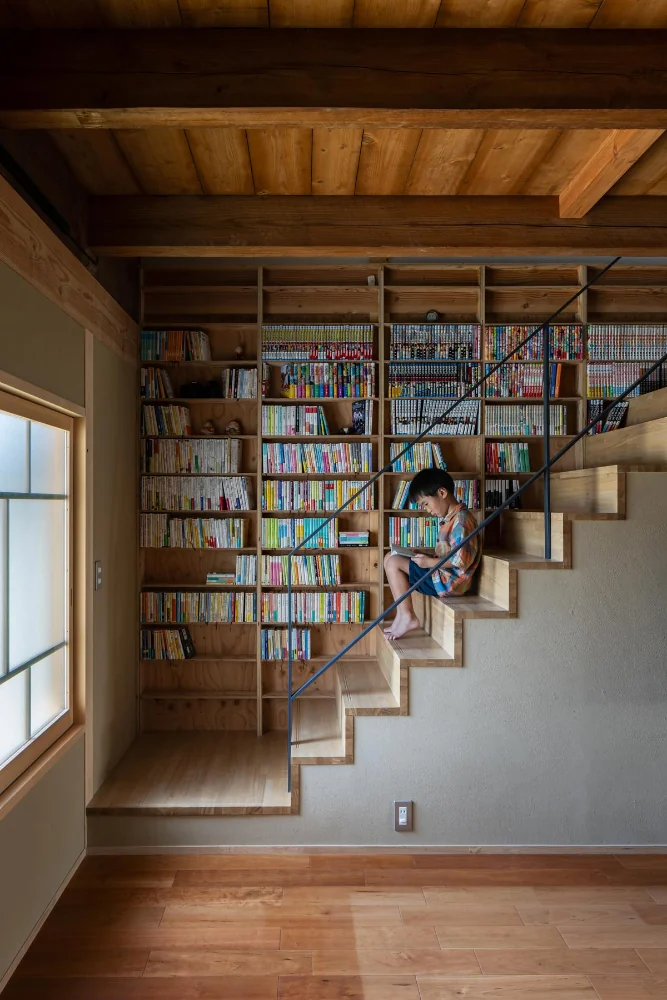
A large-capacity stair library. The rear elevation is a structural reinforcement wall.
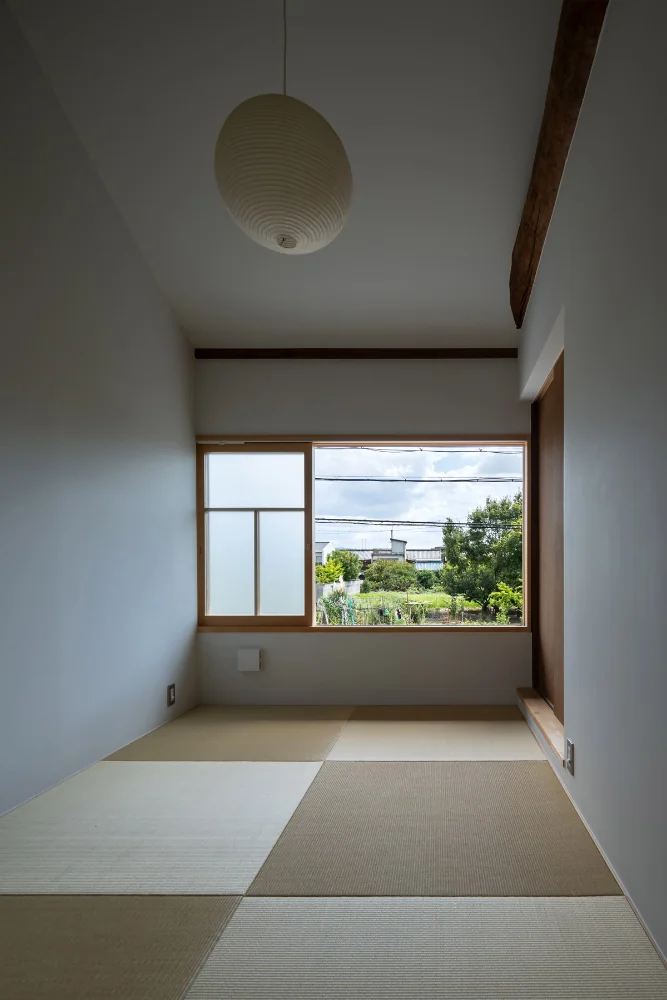
Master bedroom. Fields and paddies extend beyond the south-facing window.
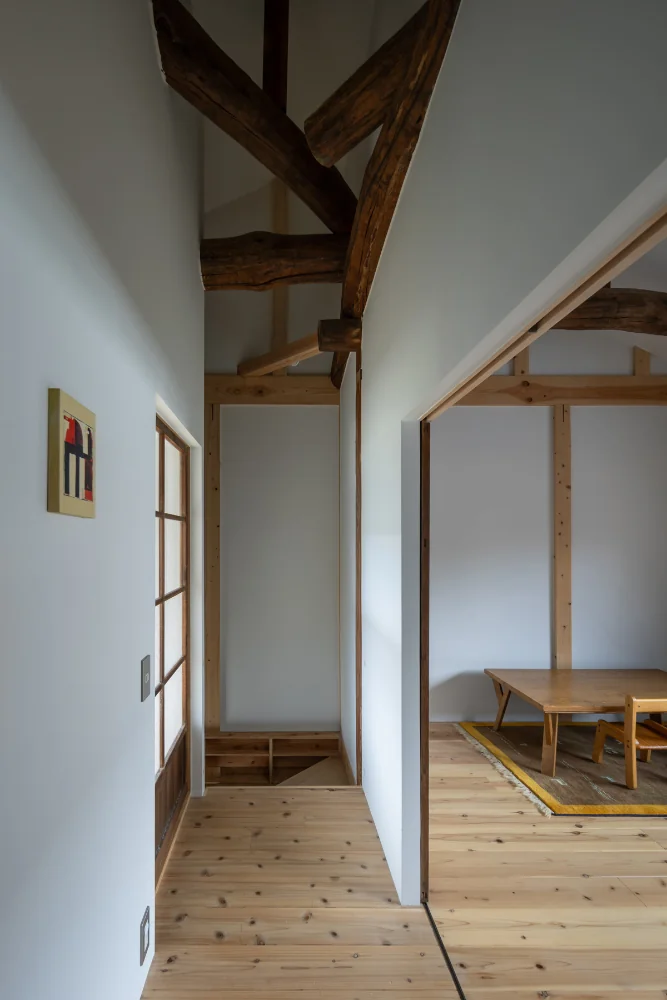
The child’s room on the right will be used open-plan for the time being; sliding partition doors can be fitted later to divide the space when needed.
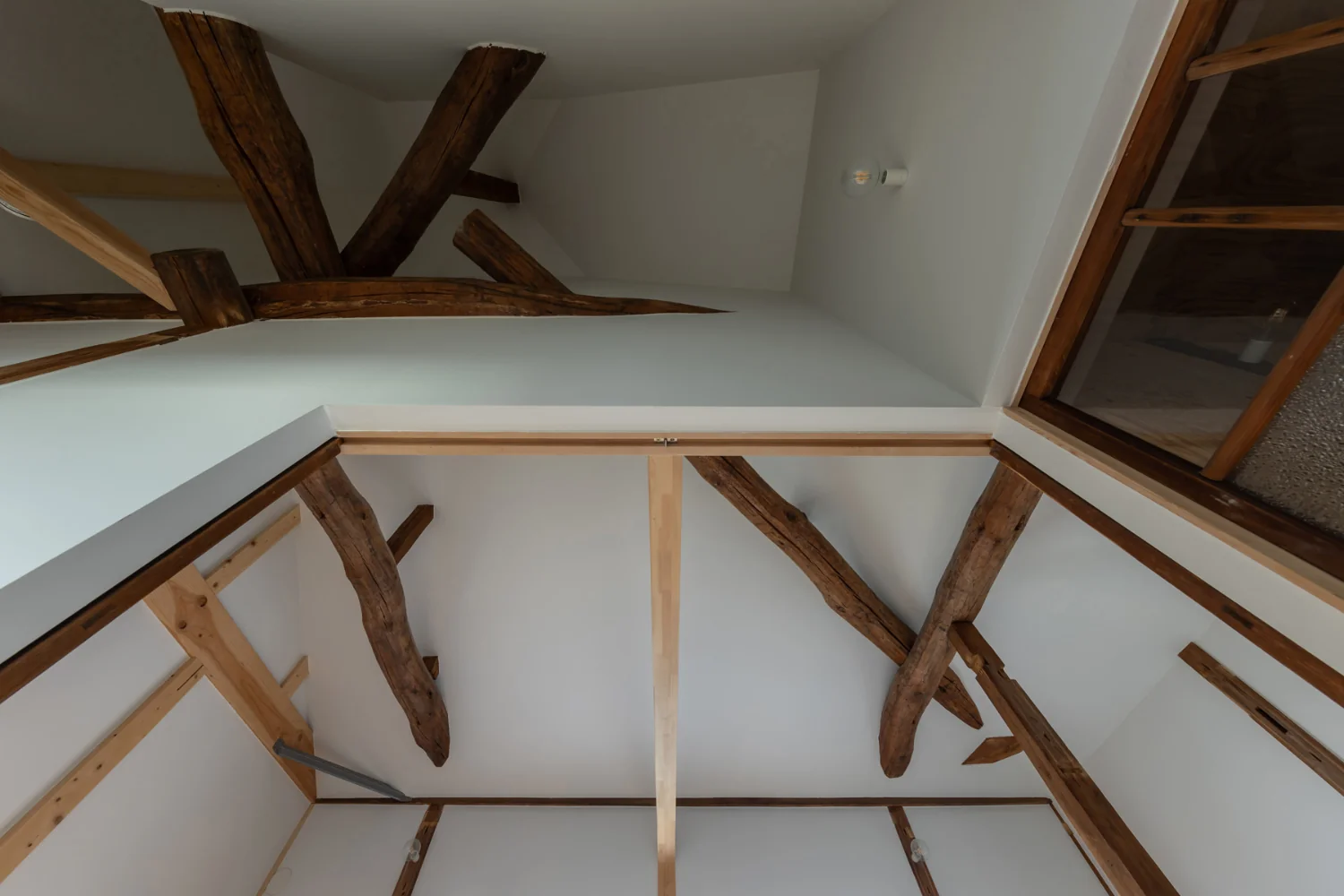
View up to the second-floor ceiling. A complex hipped-roof timber framework. Walls and ceilings painted white create a bright space.
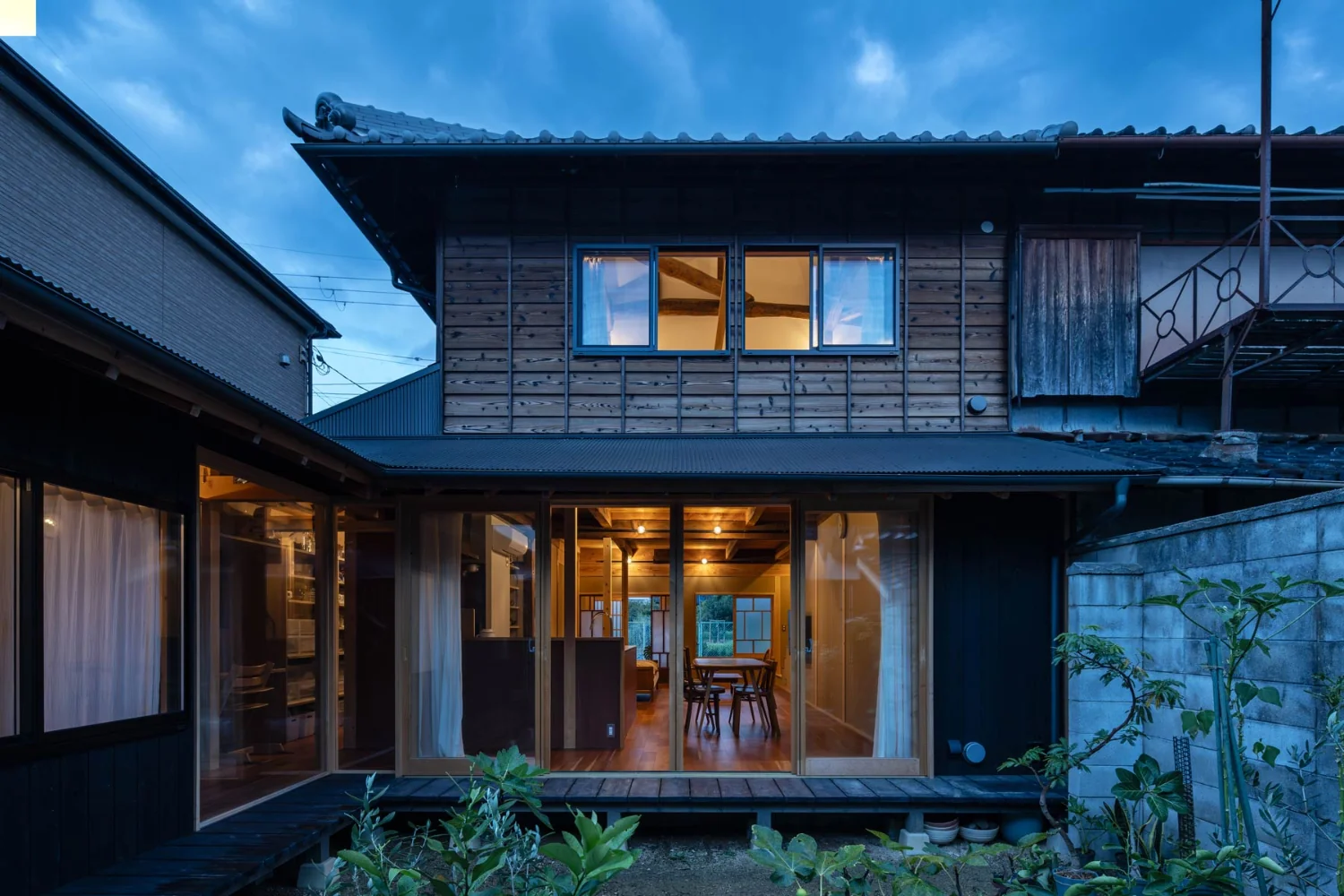
The garden with an engawa serves as a multipurpose living space for children’s play, kitchen gardening, laundry drying, and other daily activities.
Renovation
Kominka Restoration
Custom Kitchen
Traditional Japanese House
Reclaimed Wood
Display Storage
Aging Gracefully
Family with Children
Reclaimed Beam
Natural Materials
traditionalWoodenTownhouse
seismicRetrofit
seismicReinforcement
vacantHouse
A Home for Culinary Enthusiasts
Homes Featuring Wall-Mounted Bookshelves
Modern Japanese-Style Residence
Yohei Sasakura
Learn More
Central Nara Prefecture. Yagi-cho in Kashihara City developed historically as a post town along a major route. Unlike the nationally designated Important Preservation District of Imai-cho, where Edo-period streetscapes are strictly protected, Yagi-cho has comparatively relaxed regulation and contains a rich mix of building types and eras — from roadside inns and Meiji–Taisho vernacular houses to postwar Showa-era shop-houses — producing a lively, lived-in streetscape. However, the lack of strict regulation has also meant there are no special protective measures, and in recent years many pre-Showa buildings have been demolished and rapidly replaced by homogeneous streetscapes of parking lots, prefabricated developer houses, and rental apartment blocks. The client expressed a strong desire to live in Yagi-cho while contributing to the preservation and adaptive use of its historic houses and streetscape.
With the cooperation of an NPO engaged in local town planning, we acquired and renovated one side of a large vacant paired row house (two-unit longhouse). This row of five adjoining houses was constructed in the pre-war Showa period and, over roughly one hundred years, survived through successive adaptations to changing occupants and lifestyles. One unit had been demolished a few years earlier and the remaining four units were in advanced deterioration. The unit we renovated had been left sealed for about thirty years; water ingress, decay, and termite damage had progressed to the point that the building was nearly derelict.
We demolished the east half to the structural skeleton, installed a reinforced concrete slab-on-grade foundation, and replaced or spliced columns and beams to perform structural strengthening so the building would retain adequate seismic performance even if the western neighboring unit were to be removed in the future. The heavily damaged entry was completely dismantled; usable elements were carefully selected, repaired, and reassembled for reuse. The interior layout was reorganized into a highly navigable plan centered on a well-ventilated living room opening to gardens on the north and south, enhancing cross-ventilation and circulation. Thermal insulation was installed in floors, walls, and ceilings; all building services and exterior joinery were replaced; and existing timber joinery was repaired and reused to the greatest extent possible.
It is easy to discard old materials, construction methods, and spatial qualities and to build houses and streets from uniform mass-produced components, but once the accretion of cultural layers is lost it cannot be fully recovered. By carefully reading and interpreting what is old and by attentively seeking points of contact with new ways of living and thinking, we aim to create housing that connects past and future — and we hope that, over time, such projects will exert some influence on the character of the wider streetscape. Household composition | Couple + 2 children Structural scale | Timber construction, 2 stories Use | Single-family house (row house) Site area | 47 tsubo [156 m2] Gross floor area | 32 tsubo [106 m2] Construction floor area | 43 tsubo [142 m2]
Design supervision | Yoshihiro Yamamoto [YYAA] Construction | Fukumoto Komuten Kitchen | KANWORKS Garden | Shiozu Plant Research Institute
With the cooperation of an NPO engaged in local town planning, we acquired and renovated one side of a large vacant paired row house (two-unit longhouse). This row of five adjoining houses was constructed in the pre-war Showa period and, over roughly one hundred years, survived through successive adaptations to changing occupants and lifestyles. One unit had been demolished a few years earlier and the remaining four units were in advanced deterioration. The unit we renovated had been left sealed for about thirty years; water ingress, decay, and termite damage had progressed to the point that the building was nearly derelict.
We demolished the east half to the structural skeleton, installed a reinforced concrete slab-on-grade foundation, and replaced or spliced columns and beams to perform structural strengthening so the building would retain adequate seismic performance even if the western neighboring unit were to be removed in the future. The heavily damaged entry was completely dismantled; usable elements were carefully selected, repaired, and reassembled for reuse. The interior layout was reorganized into a highly navigable plan centered on a well-ventilated living room opening to gardens on the north and south, enhancing cross-ventilation and circulation. Thermal insulation was installed in floors, walls, and ceilings; all building services and exterior joinery were replaced; and existing timber joinery was repaired and reused to the greatest extent possible.
It is easy to discard old materials, construction methods, and spatial qualities and to build houses and streets from uniform mass-produced components, but once the accretion of cultural layers is lost it cannot be fully recovered. By carefully reading and interpreting what is old and by attentively seeking points of contact with new ways of living and thinking, we aim to create housing that connects past and future — and we hope that, over time, such projects will exert some influence on the character of the wider streetscape. Household composition | Couple + 2 children Structural scale | Timber construction, 2 stories Use | Single-family house (row house) Site area | 47 tsubo [156 m2] Gross floor area | 32 tsubo [106 m2] Construction floor area | 43 tsubo [142 m2]
Design supervision | Yoshihiro Yamamoto [YYAA] Construction | Fukumoto Komuten Kitchen | KANWORKS Garden | Shiozu Plant Research Institute
- Copyright(C)Qurasuki.All Rights Reserved.