Choose architectural examples of Homes with Innovative Storage Solutions and Stylish Children's Rooms for your Personal Diagnosis,
A home-building support tool to meet design offices and builders who resonate with your sensibilities.
Homes with Innovative Storage Solutions|Stylish Children's Rooms|How To
Storage Planning with the Right Materials in the Right Places.
Storage should fundamentally be located close to the areas where items are used. For example, shoes and coats near the entrance, tableware and cooking utensils in the kitchen, and clothing in the bedroom. Arranging storage with consideration to the flow of movement enhances ease of organization. It is essential to address any dissatisfaction such as "If only there were storage here" during the design phase.
A Neat Entrance with a Shoe Cloakroom.
By incorporating a shoe cloakroom adjacent to the entrance, it is possible to store not only shoes but also umbrellas, coats, strollers, and outdoor play equipment. Separating the entrance routes for guests and family members helps maintain a consistently tidy entrance. This is a thoughtful design strategy to keep the entrance, which forms the first impression, beautifully organized.
Consolidated Food Storage with a Pantry.
By incorporating a pantry adjacent to the kitchen, food stocks, cooking utensils, and tableware can be centralized in one location. This facilitates easy organization of stored ingredients, providing clear visibility of what is stored and where. It also eliminates the need to place items on the kitchen counter, allowing for a more spacious and efficient workspace.
Efficient Use of Space with Custom-Built Storage.
Dead spaces that typically arise with ready-made furniture can be eliminated with custom-built storage solutions. Storage units that perfectly fit the space—matching ceiling heights and wall irregularities—are both aesthetically pleasing and functional. Integrated storage, harmonized with the architecture, maximizes the use of the space.
Differentiating Between Display Storage and Concealed Storage.
Rather than concealing everything, utilizing display storage for aesthetically pleasing items allows them to be enjoyed as part of the interior design. Tableware, books, and hobby collections are placed on open shelving, while items that reveal everyday living are stored in cabinetry with doors. A well-balanced storage plan enriches the spatial experience.
Adaptable with Adjustable Shelves.
The items stored change along with life stages. By using adjustable shelves whose heights can be modified, the storage can flexibly accommodate everything from children's toys to documents and hobby equipment. The key to long-lasting storage solutions is adaptability.
Enhance Spaciousness with a Walk-In Closet.
Incorporating a walk-in closet in the bedroom allows for consolidated storage of clothing, bedding, suitcases, and more. It facilitates dressing within the space, streamlining daily preparations. If space permits, a full-length mirror and a vanity area can also be installed. Ample storage enriches your morning routine with ease and comfort.
Raised Tatami Area with Integrated Storage
A raised tatami area is created in a corner of the living room, with the space beneath utilized as drawer storage, thereby enhancing the living room's storage capacity. This design accommodates bulky items such as cushions, toys, and seasonal appliances. It is a clever dual-purpose solution that integrates seating and storage into a single functional element.
Completing the Laundry Workflow within the Laundry Room.
The laundry room, which consolidates the washing machine, dryer, drying rack, ironing board, and storage into a single space, enables all laundry-related tasks to be completed efficiently. This setup allows for laundry activities to proceed regardless of weather conditions, enhancing operational efficiency. It creates a comfortable environment that alleviates the considerable burden often associated with laundry chores.
Organize Outdoor Items with a Mudroom Storage.
By storing outdoor gear, sports equipment, and gardening tools in the mudroom storage adjacent to the entrance, you can avoid bringing them indoors. This allows for storing items even when dirty, ensuring a smooth experience for the next use. Storage that mediates between exterior and interior spaces enhances living comfort.
Establish Fixed Locations for Documents and Small Items.
Designating fixed locations for small items such as mail, documents, stationery, and chargers is key to maintaining organization. By incorporating shallow drawers or trays in a corner of the living room or kitchen to create a designated temporary placement area, clutter can be effectively prevented.
Storage Adapted to Children's Growth.
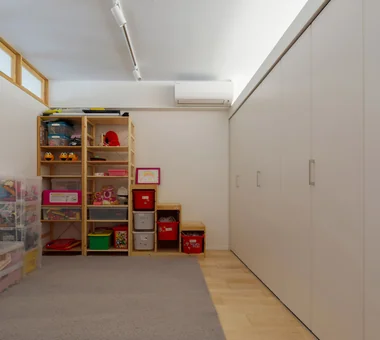
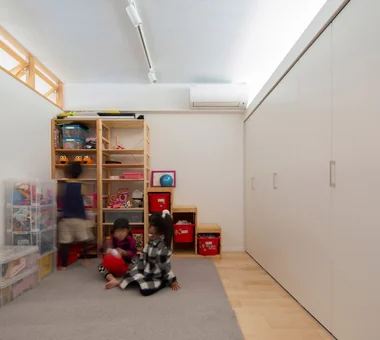
Storage in children's rooms evolves as their needs change with growth. By incorporating low-level storage that children can access and organize independently, and designing it to be adaptable to different uses over time, the storage remains functional for extended periods. Creating an environment that fosters habits of tidiness is also a fundamental role of the home.
Spatial Planning with Future Growth in Mind.
It is essential to determine the size of children's rooms based on anticipated future uses. While 4.5 to 6 tatami mats is typical, the space must accommodate a study desk, bed, storage, and play area. One approach is to utilize a larger open space during early childhood and partition it with furniture as the child grows. When siblings share a room, it is advisable to consider a layout that allows for future division.
Flexible Floor Plan.
A flexible design is effective, assuming that the usage will change according to the growth of children. Initially, the space is used as a large single room, and upon reaching adolescence, it can be divided into two rooms with partitions by thoughtfully arranging doors, storage, and windows. Installing backing for partition walls in advance facilitates easier renovations later.
Storage Planning and Ease of Tidying
Children's belongings, such as toys, books, clothing, and school supplies, change as they grow. By utilizing adjustable shelves and open storage, the way storage is used can be adapted according to their development. Considering heights and systems that make it easy for children to tidy up by themselves also fosters habits of organization and cleanliness.
Lighting Design and Consideration for the Eyes.
The lighting in the children's room fundamentally combines a main light that illuminates the entire space brightly with a desk light for study purposes. If a dimming function is available, the brightness can be lowered before bedtime to create a relaxing atmosphere. Eye-friendly LEDs are long-lasting and economical.
Selection of Wallpaper and Color Schemes.
The color scheme of a children's room should create a bright and cheerful atmosphere while also providing an environment conducive to focused study. Excessive use of primary colors can be overly stimulating; therefore, consider balancing the palette by applying accent colors to only one wall. Choosing subdued tones that remain suitable as the child grows is also a viable approach.
Selection of Flooring Materials and Playability
Since young children often play on the floor, it is advisable to use soft and warm flooring materials. Cork tiles and carpets provide cushioning to prevent injury from falls and also offer sound insulation. In the case of hardwood flooring, the use of rugs or mats can address these concerns. It is also important to consider ease of cleaning for future stages of growth.
Ensuring Safety.
It is essential to incorporate safety measures such as installing fall-prevention guards and opening restrictions on windows, fitting covers on electrical outlets, and avoiding furniture with sharp corners. While these precautions may become unnecessary as children grow, special attention is required during their early years.
Connecting with Family.
Instead of making the children's rooms completely independent, positioning them close to the living area creates an environment where the presence of family can be felt. On the other hand, privacy becomes important during adolescence, so it is essential to plan with a balanced approach, including the placement of doors.
Location and Number of Electrical Outlets
Multiple electrical outlets are required around the study desk area to accommodate lighting, computers, tablet charging, and other devices. As the types of electrical appliances used will change with growth, it is practical to install a sufficient number of outlets with some margin. The height of the outlets should also be planned in accordance with the desk position.
Innovative Display Space Design
Having a dedicated space to showcase children's artwork, certificates, and favorite posters fosters a sense of attachment to the room. Incorporating picture rails, magnetic boards, or cork boards allows for flexible and creative display options. As the occupant grows, the items displayed will change, so a system with adaptability and variability is ideal.
The Role of the Children's Room.
An increasing number of families have children studying in the dining or living areas. Therefore, it is advisable not to rigidly define the children's room solely as a "study space," but rather to consider it as a personal area where children can organize their belongings, spend quiet time alone, or play with friends.
Repurposing After Children Leave the Nest.
Planning for how rooms will be used after children become independent leads to a more efficient and sustainable floor plan over the long term. Designing spaces to be simple and highly versatile allows them to be adapted for various functions such as a study, hobby room, or guest room, which is a strategic approach to maximize utility.
Q&A
Homes with Innovative Storage Solutions|Stylish Children's Rooms|Q&A
What design strategies maximize storage capacity within limited spaces?
Utilizing dead space is key. Storage should be strategically planned under stairs, beneath floors, in attic spaces, and within wall thicknesses. Incorporating adjustable shelving and pull-out storage units enhances spatial efficiency, while custom-built storage extending to the ceiling fully exploits vertical space. Rather than dedicating an entire room solely for storage, distributing storage areas throughout the space achieves an optimal balance between usability and capacity.
What is an effective storage plan to help each family member organize their belongings?
Install locker-style storage units near the entrance for each family member, allowing them to organize their belongings immediately upon returning home. Each private room should be equipped with a closet, while shared areas can accommodate seasonal items and guest supplies. Implementing a system of labeling and color-coding is also essential so that all family members can easily identify where items are stored.
Where is the most efficient location to store seasonal items?
Items that are used only a few times a year can be stored in less accessible high or deep storage spaces without issue. Utilize attic storage, underfloor storage, or the upper sections of closets. Implement moisture-proof and insect-repellent measures, and use transparent containers or clearly labeled boxes to facilitate easy retrieval. Remember the principle of storing heavy items on lower shelves and lighter items on upper shelves.
What kind of storage system can adapt to a child's growth?
By combining adjustable shelves and modular storage units, the height and compartments of the storage can be freely modified. During early childhood, items can be stored at lower levels; in the school-age years, it can be used for school supplies; and from adolescence onward, it can be converted into private storage. It is recommended to select a highly versatile system.
How should the organization and storage of documents and important papers be planned?
Install dedicated filing cabinets in the study or utility area to organize documents by category. Separate documents used on a daily basis from those archived, arranging them according to frequency of access. Incorporate a fireproof safe to securely store critical documents. Additionally, advancing digitization is important to reduce the volume of physical paperwork.
Should the storage locations for guest supplies and emergency supplies be separated?
It is recommended to determine the placement based on frequency of use and urgency. Guest items such as futons and tableware should be stored in closets or dedicated storage spaces, while emergency supplies should be distributed near the entrance and on each floor. Since emergency supplies require regular inspection, they should be placed in visible and easily accessible locations, and it is important that all family members are aware of their whereabouts.
Do you have any ideas for using walls to stimulate children's creativity?
One very enjoyable idea is to finish a portion of the wall with a magnetic board that can hold magnets, a whiteboard surface that can be freely written on and erased, or chalkboard paint. This allows children to express themselves and draw freely without the worry of damaging the walls. It can also be utilized as a gallery space to display and showcase their artwork.
Please explain the lighting plan for a children's room.
It is important to plan separate lighting for study and relaxation purposes. For the desk area, we recommend using dimmable task lighting, while the general illumination should be provided by warm-toned LEDs. Additionally, incorporating indirect lighting for bedtime can create a high-quality sleep environment.
How should one approach the storage planning for children's rooms?
It is recommended to provide storage for daily necessities at a height appropriate to the child's eye level, with an adjustable shelving system that can be modified as the child grows. For toy storage, a combination of open display and concealed storage should be used to encourage the habit of tidying up.
What are the key considerations when creating a study space in a children's room?
An ideal location utilizes natural light near a window. It is recommended to provide a desk with a depth of at least 60 cm and position bookshelves within easy reach. Additionally, to promote concentration, it is important to visually separate the study area from play zones. Installing cork boards or similar features on the walls can also help enhance motivation for learning.
Please share ideas for a children's room used by siblings.
A design incorporating movable partitions to divide the space is recommended. This approach ensures each child has a private area while allowing for communication in shared zones. It is important to provide individual storage and study spaces to create an environment that respects each other's belongings.
Children often study in the living room. How should the role of the children's room be considered?
It is not necessary to equate studying strictly with the children's room. If studying primarily takes place in the living room, the children's room can be regarded as a 'personal space' where the child manages their belongings, spends quiet time alone, or plays with friends. This role naturally evolves as the child grows.
Home building starts with what you love. A place to visualize your sensibilities and achieve a lifestyle that is uniquely yours.
Pick architectural photos to automatically analyze your sensibilities. Visualize your unspoken 'likes' and find professionals who share your values.
Shape your ideal home with intuitive operations. How to enjoy Qurasuki even if it's your first time.
No special knowledge required. Just browse photos and pick what moves you to reveal your style and meet experts who can fulfill your dreams.
Save Photos You Love
Just tap '♡'. Whether you know your style or are just starting, begin by freely collecting the seeds of your ideal home.
'Auto-Analysis' to Decode Your Sensibility
Analyzes preferences from your saved photos. Uncover your 'true ideal' by visualizing the tastes you couldn't put into words.
Discover Professionals through Diagnosis
Find experts who match your sensibilities. Explore their philosophies and projects to find a partner who shares your values.
Experience Your Ideal through Events
Join open houses or events hosted by experts you like. Deepen your trust and peace of mind by experiencing actual spaces.