KICHI ARCHITECTURAL DESIGN
Stylish Staircases|Key Points for Home Building|Design Innovations for Vertical Spaces Combining Safety and Aesthetics
Author: Qurasuki Editorial Department
Stairs are not merely a means of vertical circulation but serve as spaces that enable a three-dimensional spatial experience. Elements such as the number of steps, riser height, tread depth, natural lighting penetration, and handrail detailing cohesively connect the upper and lower spaces in a comfortable manner. While ensuring safety, the inherent beauty of these stairs subtly enhances daily living satisfaction through repeated ascents and descents.
Dimensions of Slope, Tread, and Riser.
The ease of ascending and descending stairs is determined by the slope. According to the Building Standards Act, residential stairs must have risers of 23 cm or less and treads of 15 cm or more. However, for comfort, risers of approximately 18 to 20 cm and treads of about 20 to 22 cm are generally preferred. A balance where "(riser × 2) + tread ≈ 60 cm" is considered optimal for comfortable stair usage.
Selection of Staircase Configuration
Straight staircases are simple and space-efficient; however, they lack landings, which increases the risk of falls. U-shaped and L-shaped staircases include landings, enhancing safety, while spiral staircases serve as spatial focal points. The choice of configuration should be made comprehensively, considering site conditions, budget, safety, and design aesthetics.
Installation and Height of Handrails.
Handrails are a critical element in ensuring the safety of staircases. Installing them on both sides, rather than just one, enhances safety. The standard height is approximately 75 to 85 cm from the floor surface, but it can be adjusted according to the user's height. The design of the handrail also influences the overall impression of the staircase, so it is important to select a solution that balances both functionality and aesthetics.
Lighting Design and Footing Safety.
Staircases are areas with a high risk of falls, making adequate illumination essential. A lighting plan that effectively highlights each step edge—such as footlights illuminating the edges of each tread or indirect lighting installed on walls—creates shadows while clearly defining the risers. Incorporating motion sensors further enhances safety during nighttime use.
Presence or Absence of Risers
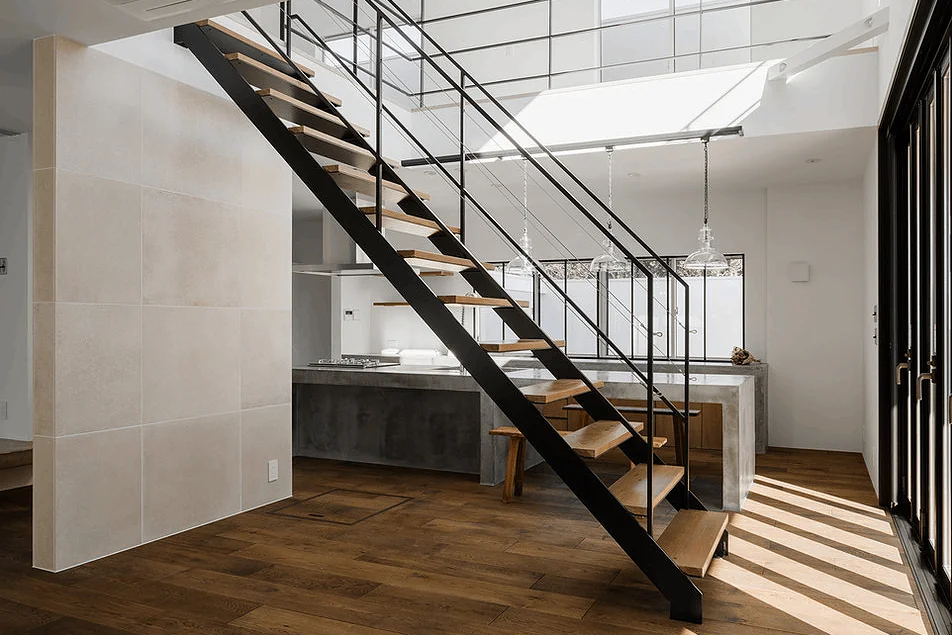
Skeleton stairs without risers create an open and airy impression by allowing sightlines to pass through. When combined with a double-height space, this design enhances the sense of spatial expansiveness. Conversely, stairs with risers provide a sense of security and reduce the risk of objects falling through. For households with small children or pets, stairs equipped with risers offer greater safety.
Stair Placement and Circulation Flow.
The placement of stairs determines the overall circulation flow of the house. Positioning stairs in the entrance hall allows direct access to the private rooms on the second floor, while opting for a living room staircase creates a layout where family members can easily see each other. Each option has its advantages and disadvantages, so it is important to choose according to the family’s lifestyle.
Material Selection and Texture.
The materials used for stair treads, risers, and handrails greatly influence the ambiance of the space. Wood imparts warmth, while steel conveys a sharp and modern aesthetic. When selecting materials, consider slip resistance and durability, ensuring harmony with the overall interior design.
Utilization of Under-Stair Space
The space beneath stairs can be utilized for various purposes such as storage, a restroom, or a study nook. Due to its irregular shape, custom-built shelving is an efficient solution. However, in the case of an open staircase in the living area, keeping the under-stair space open enhances the sense of spaciousness within the room. It is important to plan with a balanced consideration of both function and design.
Relationship with the Atrium
By positioning the staircase adjacent to the atrium, a sense of visual expansiveness and enhanced natural light can be achieved. This arrangement allows occupants to overlook the lower floor from the upper level and to experience the spatial entirety while ascending the stairs. However, it is important to comprehensively consider the potential impacts on acoustics and thermal comfort.
Designing Landings.
When a straight staircase has many steps, incorporating a landing midway enhances safety. Landings also serve as resting areas and reduce the risk of injury in the event of a fall. Installing windows in the landing ensures adequate natural lighting and ventilation.
Design Appeal and Spatial Accents.
Staircases serve not only as functional elements but also as spatial accents. By highlighting the natural beauty of wood grain or meticulously designing the handrails, they can assert a commanding presence as focal points within the interior.
Consideration for Future Safety.
Staircases require careful design to ensure safe use during advanced age. This includes implementing gentle slopes, installing structural supports to accommodate handrails on both sides, and providing adequate lighting. Such measures contribute to staircases that can be used safely and comfortably over the long term. Additionally, reserving space for the potential future installation of a home elevator is a viable option.




 Homes with Atelier Spaces|Key Points for Home Building|An Optimal Atelier Environment for Creative Practice: Daylighting, Ventilation, and Exhibition
 Homes with Scenic Views|Custom Home Examples by Architectural Offices|A Residence Where the View Becomes Part of Everyday Living
 Homes Featuring Soundproof Rooms|Introduction to Architecture Firms|A Place to Fully Enjoy Musical Performance
 Two-Generation Home|Custom Home Examples by Architectural Offices|A Home Where Two Families Coexist Harmoniously
 Stylish Dining Spaces|Key Points for Home Building|Creating Spaces That Enrich Mealtime
 Single-Story Houses|Introduction to Architecture Firms|The richness of a home contained entirely on one level