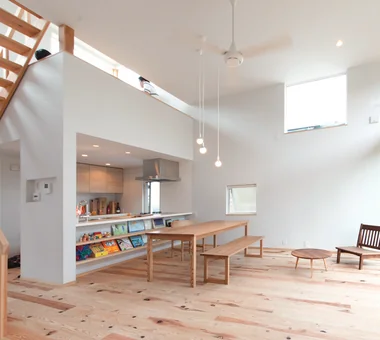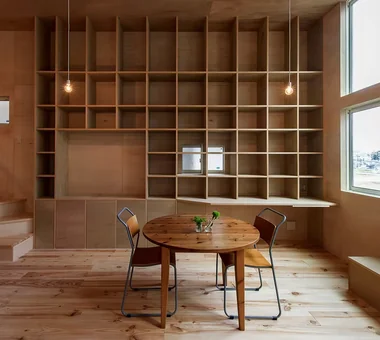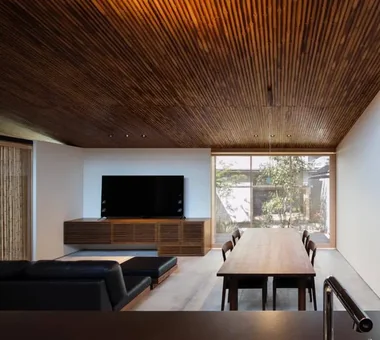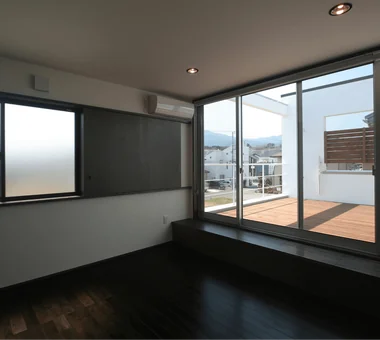
In-Ex Design Co., Ltd.
Circulation Flow|Custom-built homes by architecture firms9Picks|Designing for Ease of Living with Continuous Circulation
Author: Qurasuki Editorial Department
A “circulation” plan (kaikyū dōsen) is a layout strategy that enables movement through a home in a continuous loop rather than along one-way routes. It is a design approach that increases the flexibility of the floor plan and enhances everyday livability. Centered around the kitchen, a looped circulation can optimize household workflows by linking the pantry, washbasin, and laundry room; serve as an indoor play circuit where children can move freely; and, by providing multiple paths, create effective cross-ventilation routes. The benefits of continuous circulation are manifold. The design firm carefully analyzes family composition, daily rhythms, and household routines to design movement flows that are easy, intuitive, and low-stress, integrated directly with the spatial design. We present case studies of residences where daily life naturally and smoothly unfolds.

A Second Home in Yatsugatake
Tatsumi Negishi Architectural Studio
-
-
-
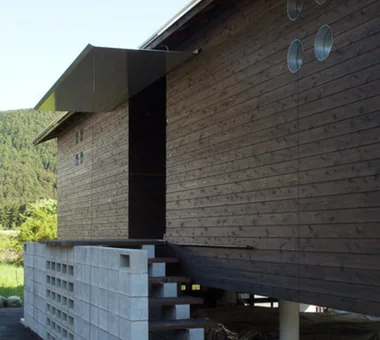
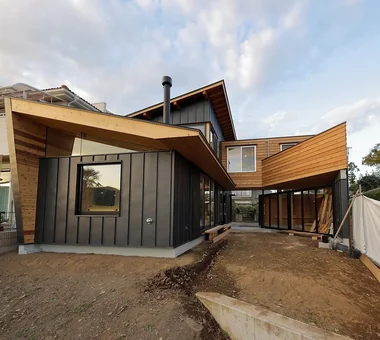
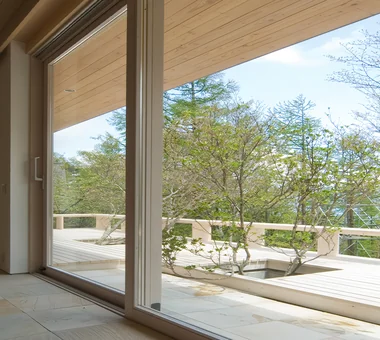
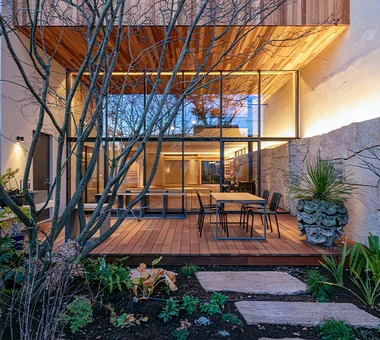
Terrace cantilevered over the sloped terrain with deep eaves
Tatsumi Negishi Architectural Studio532-5 Nakazawa, Hidaka City, Saitama Prefecture, Japan -
-
-
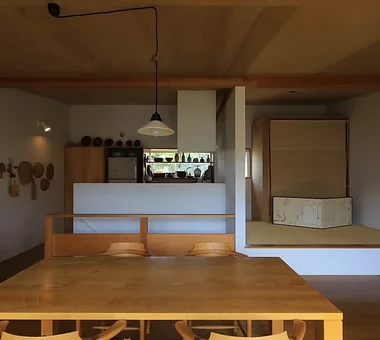
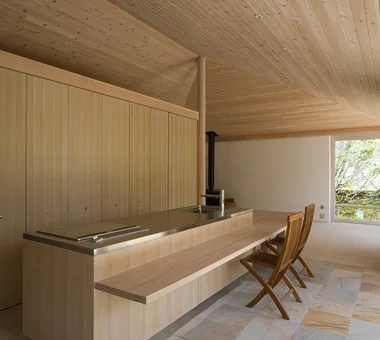
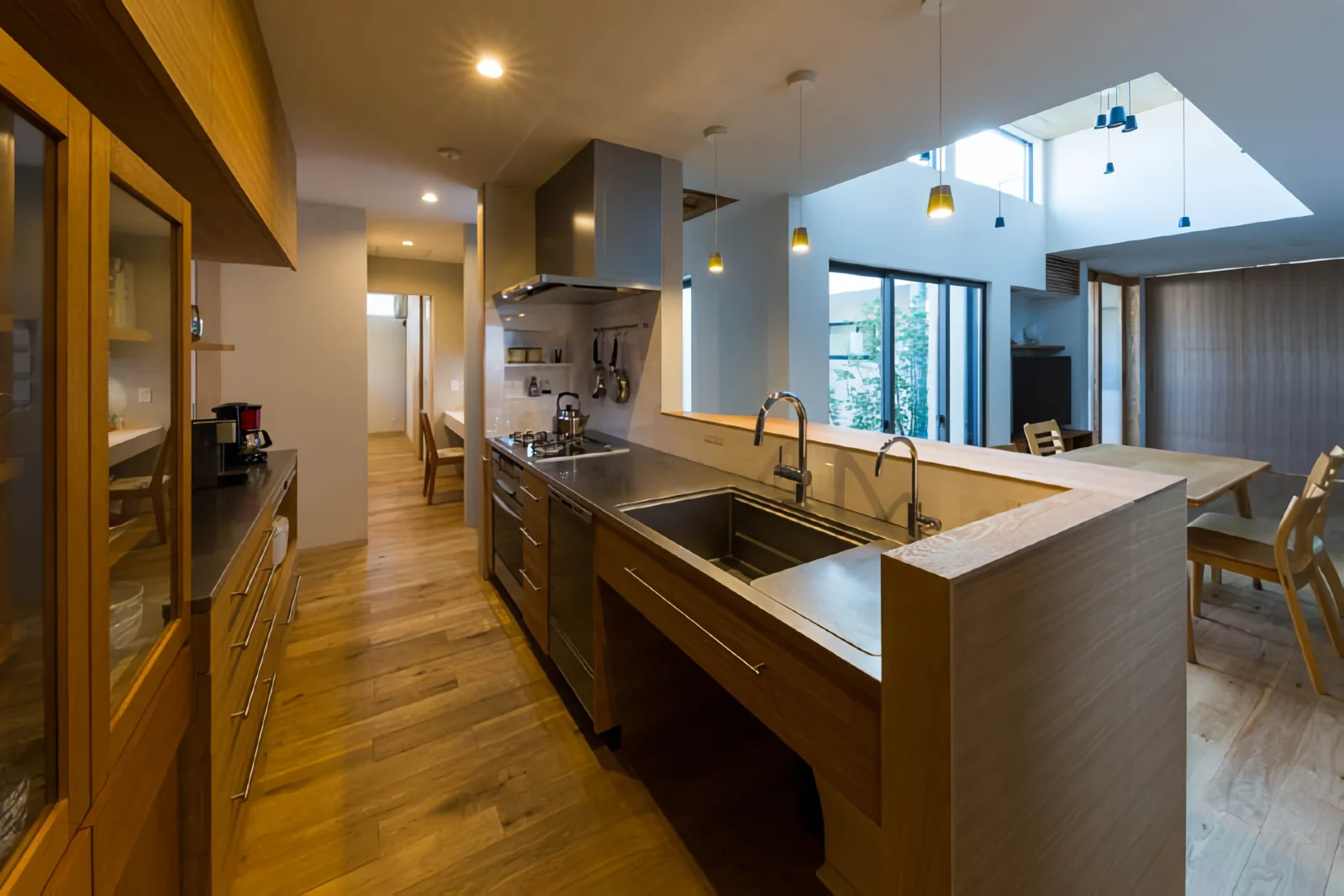
An island kitchen that allows household chores to be performed while enjoying views of the outdoors
Tatsumi Negishi Architectural Studio532-5 Nakazawa, Hidaka City, Saitama Prefecture, Japan
Residence in Kurashiki
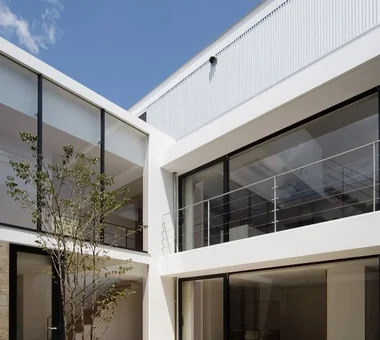
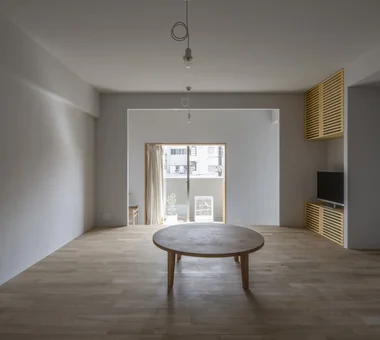
In-Ex Design Co., Ltd.
-
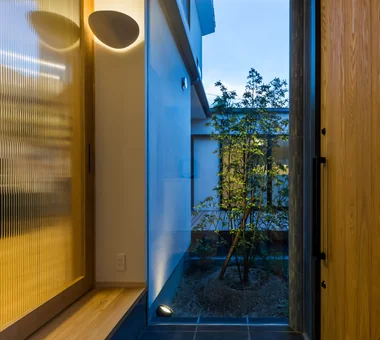
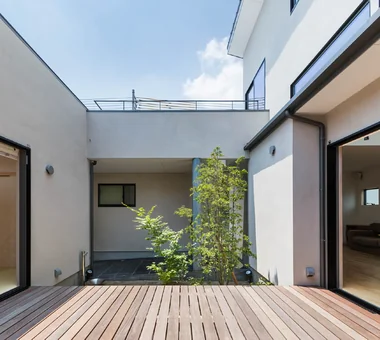
Beyond the horizontal slit is the utility area, allowing occupants to feel connected to the courtyard while performing household tasks.
In-Ex Design Co., Ltd.4-59 Takanoizumicho, Sakyo Ward, Kyoto City, Kyoto Prefecture -
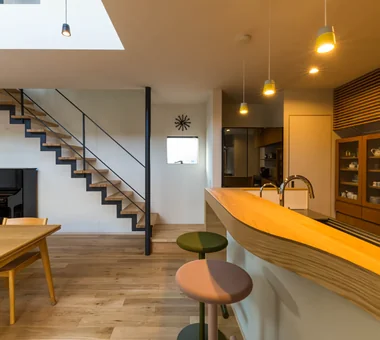
Passing through the kitchen leads to the utility space, which further connects seamlessly to the master bedroom beyond.

In-Ex Design Co., Ltd.4-59 Takanoizumicho, Sakyo Ward, Kyoto City, Kyoto Prefecture -
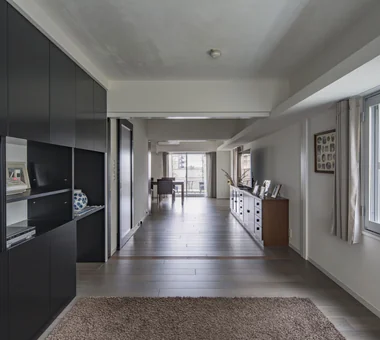
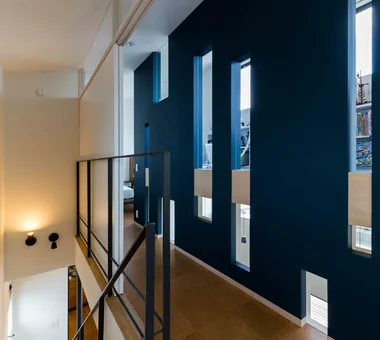
Corridor facing the courtyard; beyond the slit opening lies the utility space.
In-Ex Design Co., Ltd.4-59 Takanoizumicho, Sakyo Ward, Kyoto City, Kyoto Prefecture -
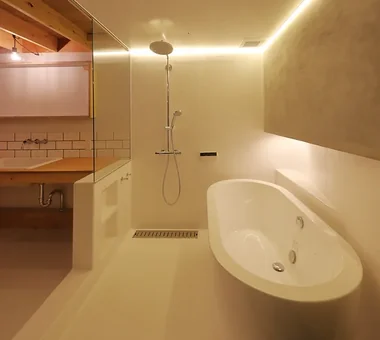
The corridor connects continuously and in a loop from the washroom and dressing room, bathroom, utility space, walk-in closet, to the terrace.
In-Ex Design Co., Ltd.4-59 Takanoizumicho, Sakyo Ward, Kyoto City, Kyoto Prefecture -
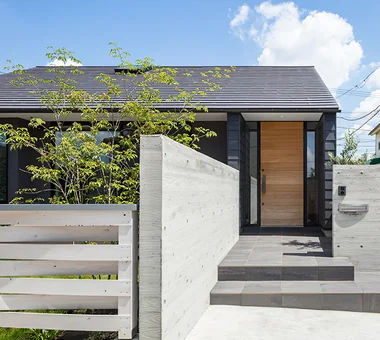
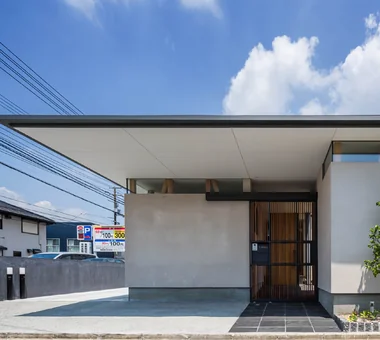
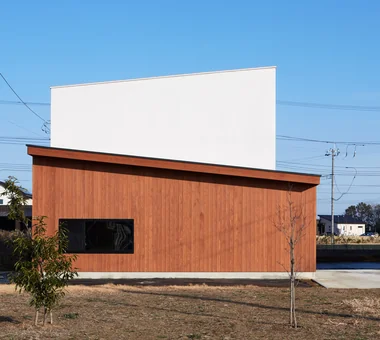
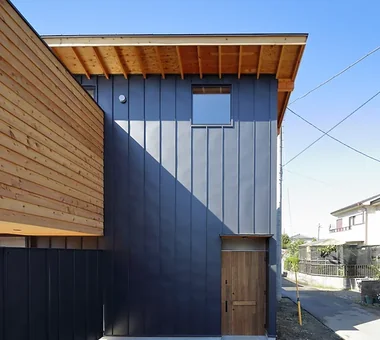
Inserting a horizontal slit between the roof and walls was conceived to establish the building’s presence.
In-Ex Design Co., Ltd.4-59 Takanoizumicho, Sakyo Ward, Kyoto City, Kyoto Prefecture -
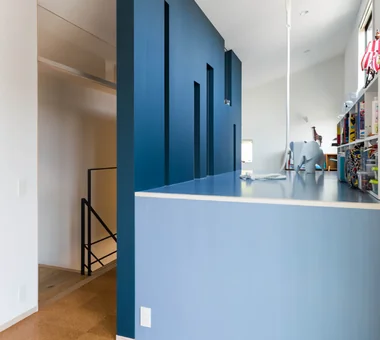
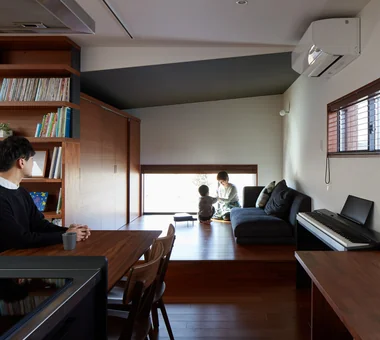
The raised floor is shared between the children’s spaces located on both sides.
In-Ex Design Co., Ltd.4-59 Takanoizumicho, Sakyo Ward, Kyoto City, Kyoto Prefecture
Hybrid House Along the Tokigawa River
H₂O Design Office
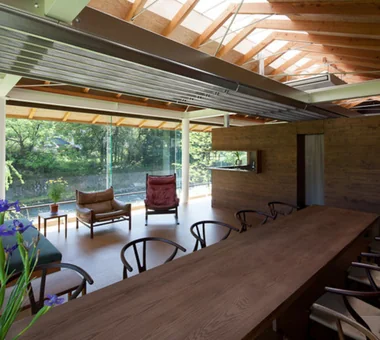
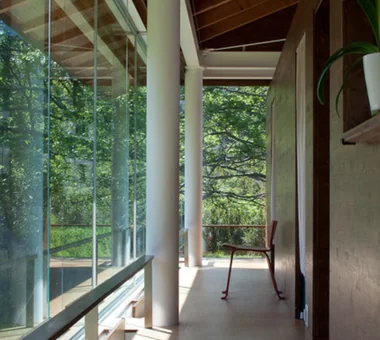
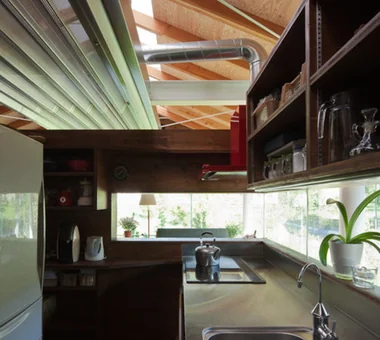
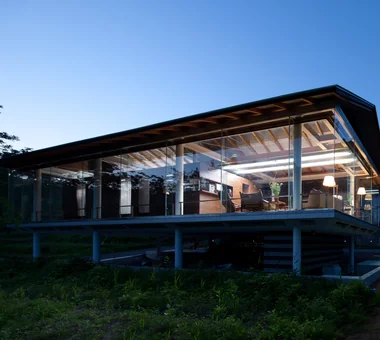
This glass house, a steel-wood-glass hybrid structure, is located within a 50 km radius of the city center on an approximately 220-tsubo site (≈727 m²) on the north bank of the Tokigawa River in Saitama Prefecture. It faces directly onto the Tokigawa with the Chichibu mountain range as its backdrop. The second-floor living level is organized as a looped circulation pattern, achieving an integrated thermal environment and daylighting under a single roof. Because the exterior walls have no operable openings, the building is equipped with a ventilation system that employs horizontally projecting, louver-like operable devices cantilevered from the second-floor slab combined with buoyancy-driven (stack) ventilation to exhaust air via a rooftop mechanical ventilator.
-
A glass house offering a unified thermal environment with abundant natural light and spatial presence
H2O Design Office939-73 Higashi-Arai, Minuma-ku, Saitama City, Saitama Prefecture -
Hybrid House Along the Tokigawa River
H2O Design Office939-73 Higashi-Arai, Minuma-ku, Saitama City, Saitama Prefecture -
Hybrid House Along the Tokigawa River
H2O Design Office939-73 Higashi-Arai, Minuma-ku, Saitama City, Saitama Prefecture -
Hybrid House Along the Tokigawa River
H2O Design Office939-73 Higashi-Arai, Minuma-ku, Saitama City, Saitama Prefecture -
Hybrid House Along the Tokigawa River
H2O Design Office939-73 Higashi-Arai, Minuma-ku, Saitama City, Saitama Prefecture -
Hybrid House Along the Tokigawa River
H2O Design Office939-73 Higashi-Arai, Minuma-ku, Saitama City, Saitama Prefecture
FOLD
JYU ARCHITECT
This is a fully separated two-family residence with high thermal insulation, engineered to seismic Grade 3 performance and augmented by a seismic-damping system. Because the surrounding context does not offer favourable views, the design adopts a courtyard-house typology; the street-facing volume is kept low to respect the streetscape, while inclined walls articulate the building’s relationship with the neighbourhood. A permeable circulation strategy, differentiated floor levels and deliberately controlled ceiling heights by function, together with the use of natural materials, produce a variety of spatial configurations while ensuring daylighting and natural ventilation.
-
-
-
-
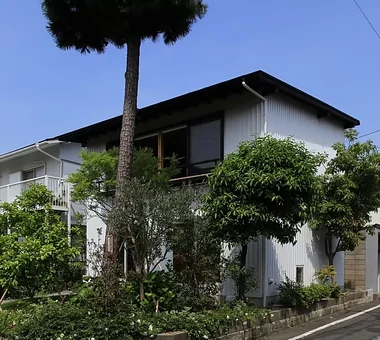
The exterior's inclined wall design fosters a conscious relationship with the building, enhancing a sense of attachment.
JYU ARCHITECT2-19-19 Nakane, Meguro-ku, Tokyo -
-
A House with a Lush Green Atelier
Archiplace
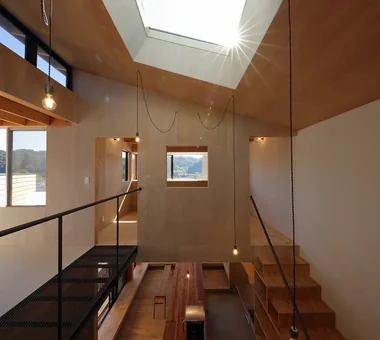
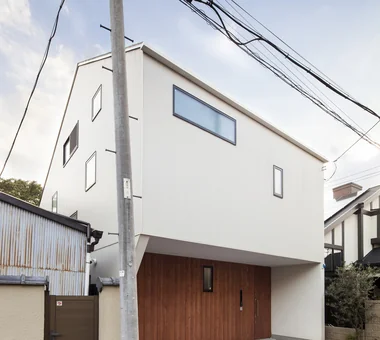
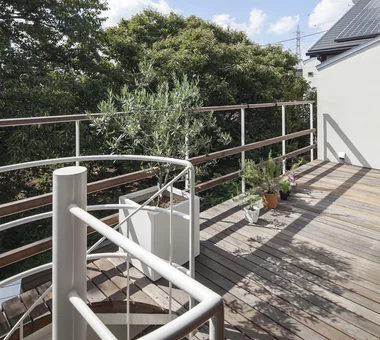
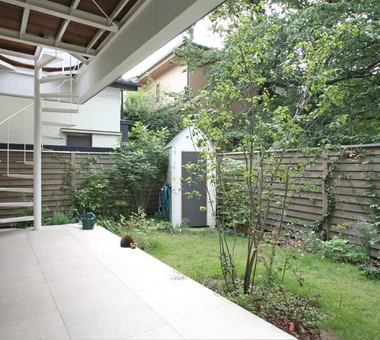
An atelier-attached residence for an owner engaged in design. Situated in a residential neighborhood of Tokyo yet taking advantage of abundant south-facing greenery, the ground floor accommodates a ceramics atelier and a garden. The second floor separates sleeping quarters and wet areas from the open-plan living, dining and kitchen, while a central double-height void and a circulating floor plan reinforce spatial connectivity. A deck terrace and a spiral staircase provide continuity with the garden, creating a home where everyday life and creative practice are gently intertwined.
-
The front wall is finished with durable brick tiles, accommodating the electric kiln and a washbasin.
Archiplace502 Palm House Hatsudai, 1-20-2 Honmachi, Shibuya-ku, Tokyo -
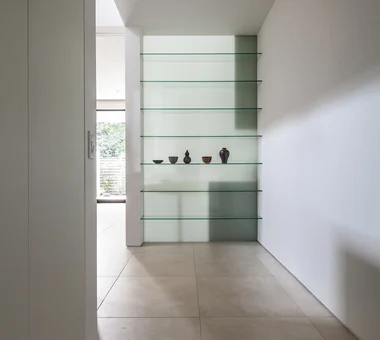
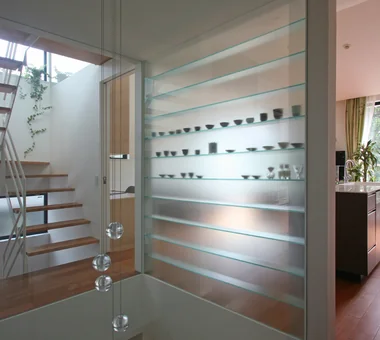
Upon entering the foyer, a glass display shelf illuminated by southern light warmly welcomes visitors.
Archiplace502 Palm House Hatsudai, 1-20-2 Honmachi, Shibuya-ku, Tokyo -
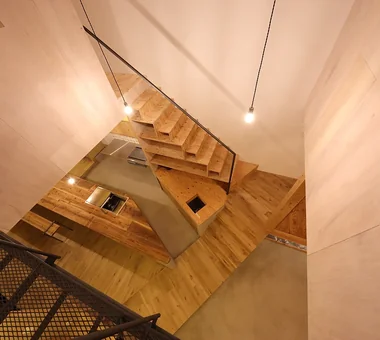
A centrally located atrium gently connects the living quarters and the atelier.
Archiplace502 Palm House Hatsudai, 1-20-2 Honmachi, Shibuya-ku, Tokyo -
From the living room, the deck terrace offers borrowed views of the neighboring greenery.
Archiplace502 Palm House Hatsudai, 1-20-2 Honmachi, Shibuya-ku, Tokyo -
The layout enables continuous circulation between the washroom, LDK, and bedroom.
Archiplace502 Palm House Hatsudai, 1-20-2 Honmachi, Shibuya-ku, Tokyo -
In the atelier, the husband operates the kiln, while the wife tends the Monet-inspired garden beyond.
Archiplace502 Palm House Hatsudai, 1-20-2 Honmachi, Shibuya-ku, Tokyo
Unuma House
Kota Goto Architectural Studio
An architect's own residence located at the northern edge of the Nōbi Plain on a site with a pronounced level change where the plain meets upland terrain. The square plan is rotated 45° to reconcile openness and privacy by avoiding direct sightlines from the main road and neighboring houses. The site's elevation difference is used so that primary living spaces are on the second floor. A hybrid concrete-and-wood structure leaves materials exposed to express their natural qualities. The layout centers on the dining area and allows for continuous circulation so that, except for sleeping, daily life takes place on the second floor. Materials such as solid timber, brass, and stone were chosen to develop patina over time and to harmonize with the southern rural landscape.
Renovation of a Detached House with a Cloistered Corridor | Koriyama House
Yoshihiro Yamamoto Architects Associates
A large steel-frame detached house was renovated by fully refurbishing the second floor to create a separated two-family residence: parents on the first floor and children on the second. A spacious 40-tatami living‑dining‑kitchen (LDK) is the focal point of domestic life; rooms and wet areas are arranged in a bead-like sequence along the window perimeter, while a large pantry and family closet occupy the central, unlit core to form a highly circulatory plan. The family closet is surrounded by an indirectly lit corridor, adding definition and contrast to the otherwise expansive space.
-
-
Island kitchen positioned at the center of the generous 40-tatami LDK. Ceiling height is 2,700 mm.
Yoshihiro Yamamoto Architects Associates302, Zeniya Honpo Main Building, 14-6 Ishigatsujichō, Tennōji-ku, Osaka -
A cubic volume that contains the family closet. The LDK is on the right; the bedroom is on the left.
Yoshihiro Yamamoto Architects Associates302, Zeniya Honpo Main Building, 14-6 Ishigatsujichō, Tennōji-ku, Osaka -
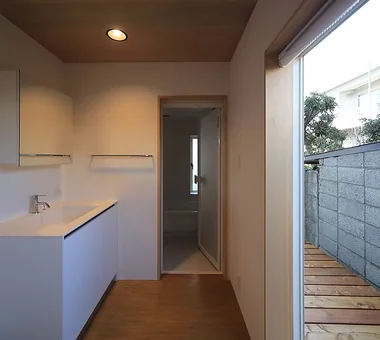
The washbasin is located at a corner of the corridor, separate from the bathroom and dressing area. The counter is the same material as the kitchen worktop.
Yoshihiro Yamamoto Architects Associates302, Zeniya Honpo Main Building, 14-6 Ishigatsujichō, Tennōji-ku, Osaka -
From the kitchen, the existing stained glass can be seen across the stairwell atrium.
Yoshihiro Yamamoto Architects Associates302, Zeniya Honpo Main Building, 14-6 Ishigatsujichō, Tennōji-ku, Osaka -
Large island kitchen, 3,600 mm in length. Side panels clad in limestone.
Yoshihiro Yamamoto Architects Associates302, Zeniya Honpo Main Building, 14-6 Ishigatsujichō, Tennōji-ku, Osaka
House in Tsukahara
Tenkosha First-Class Architects Office
A 2LDK dwelling sited on a parcel elongated along the east–west axis. A roadway borders the east side, an approximately 2.0 m high embankment/retaining slope lies to the west, and a north-side diagonal plane (height) restriction applies, making the layout and the relationship to the exterior key considerations. The entrance includes an ample shoe closet; adjacent to the kitchen are a pantry and a utility/housework room; a dedicated study for remote work is also provided. A courtyard on the first floor secures daylighting for the 24-tatami LDK (approximately 39.6 m²). With the staircase as the organizing axis, service rooms are arranged in a continuous line to the north, while the living room and a workspace are located to the south. The design achieves thermal insulation grade 5, primary energy consumption grade 6, and seismic resistance grade 2.
-
-
-
-
-
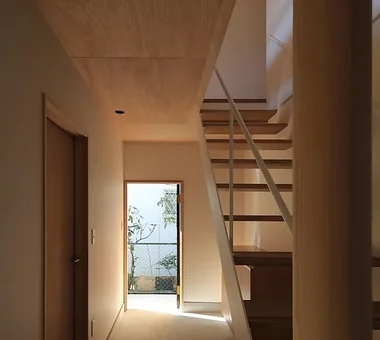
Household service rooms aligned linearly to the north side, organized around the staircase
Tenkosha First-Class Architects Office302, Showa Building Minami, 314 Ogikubo, Odawara City, Kanagawa Prefecture -
The 24-tatami mat LDK with a courtyard is a bright and relaxing living space
Tenkosha First-Class Architects Office302, Showa Building Minami, 314 Ogikubo, Odawara City, Kanagawa Prefecture
House in Akiruno
Mochizuki Architectural Atelier
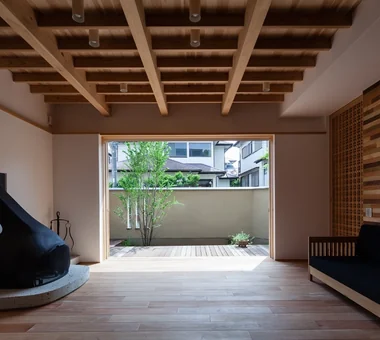
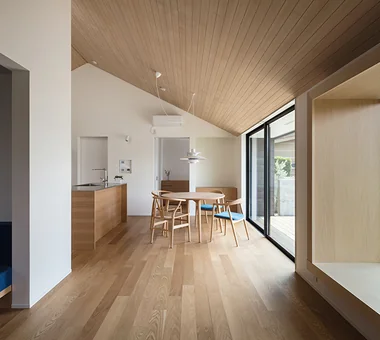
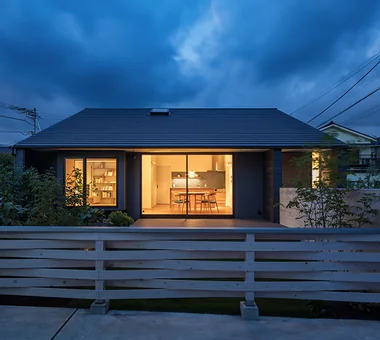
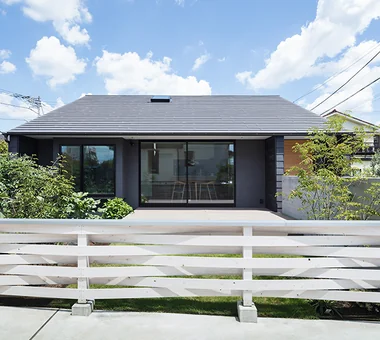
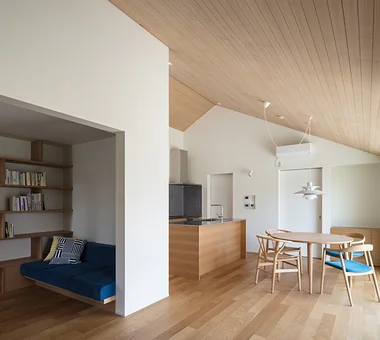
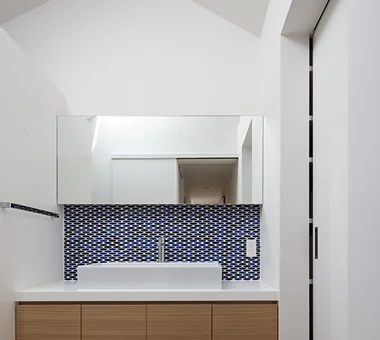
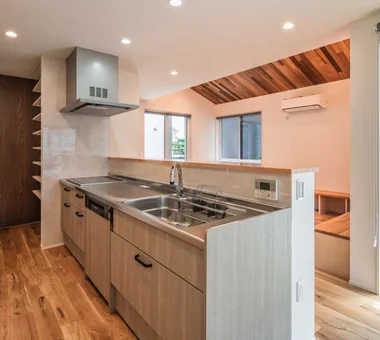
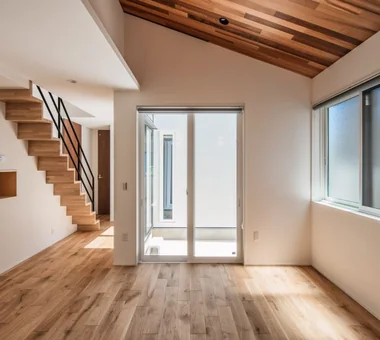
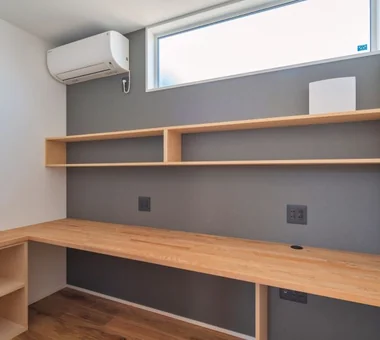
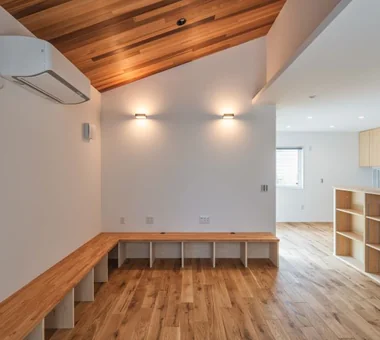
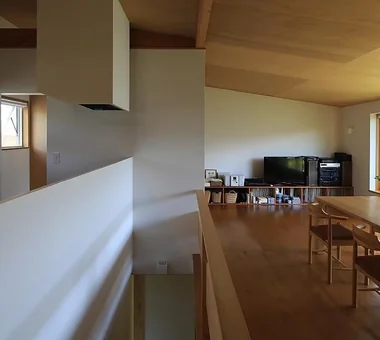
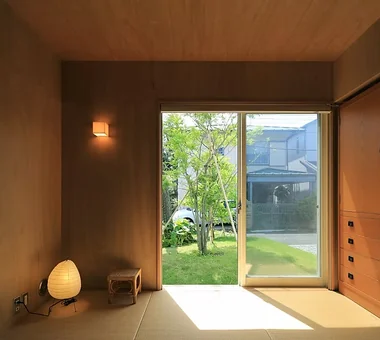
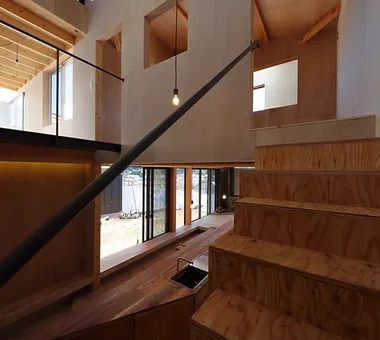
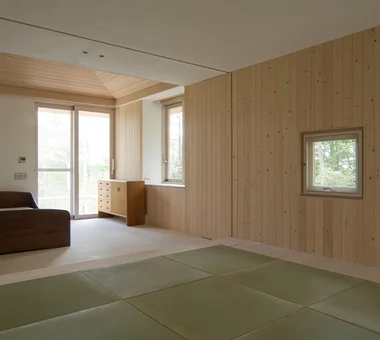
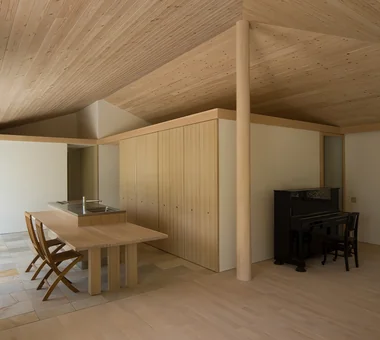
The site is located on the suburban fringe near the city and is adjacent to parking and similar uses, so the design responds to privacy and noise considerations. The proposal is a single‑storey dwelling accented by a gabled (triangular) roof. The open-plan living/dining/kitchen (LDK) is a spacious volume with ceilings elevated to follow the roofline; within the living area a built-in sofa corner with a lowered ceiling and a bay-window bench are provided. The dining area opens onto a generous deck and garden, and the household work sequence runs from a bespoke kitchen through a pantry to the wash/wet room; the plan also incorporates a looped circulation connecting a small Japanese-style room (washitsu) and the bedroom.
-
Stylish Kitchens|Key Points for Home Building|Balancing Cooking Efficiency and Comfort2025-10-20|Qurasuki Editorial Department -
Homes for Design Enthusiasts|Custom-built homes by architecture firms|A Home Infused with Aesthetic Sensibility2026-05-11|Qurasuki Editorial Department -
Homes Featuring Dedicated Theater Rooms|Introduction to Architecture Firms|Living in a Space Immersed in Visual Media2026-06-24|Qurasuki Editorial Department -
Homes Featuring Wood-Burning Stoves|Custom-built homes by architecture firms|Living with the Warmth of Fire2026-05-11|Qurasuki Editorial Department -
Modern Residences|Key Points for Home Building|Refined Spatial Design Integrating Functionality and Aesthetics2026-03-02|Qurasuki Editorial Department -
Homes with Scenic Views|Key Points for Home Building|Design Guidelines for Window Placement Considering Seasonal Variation2026-03-02|Qurasuki Editorial Department